
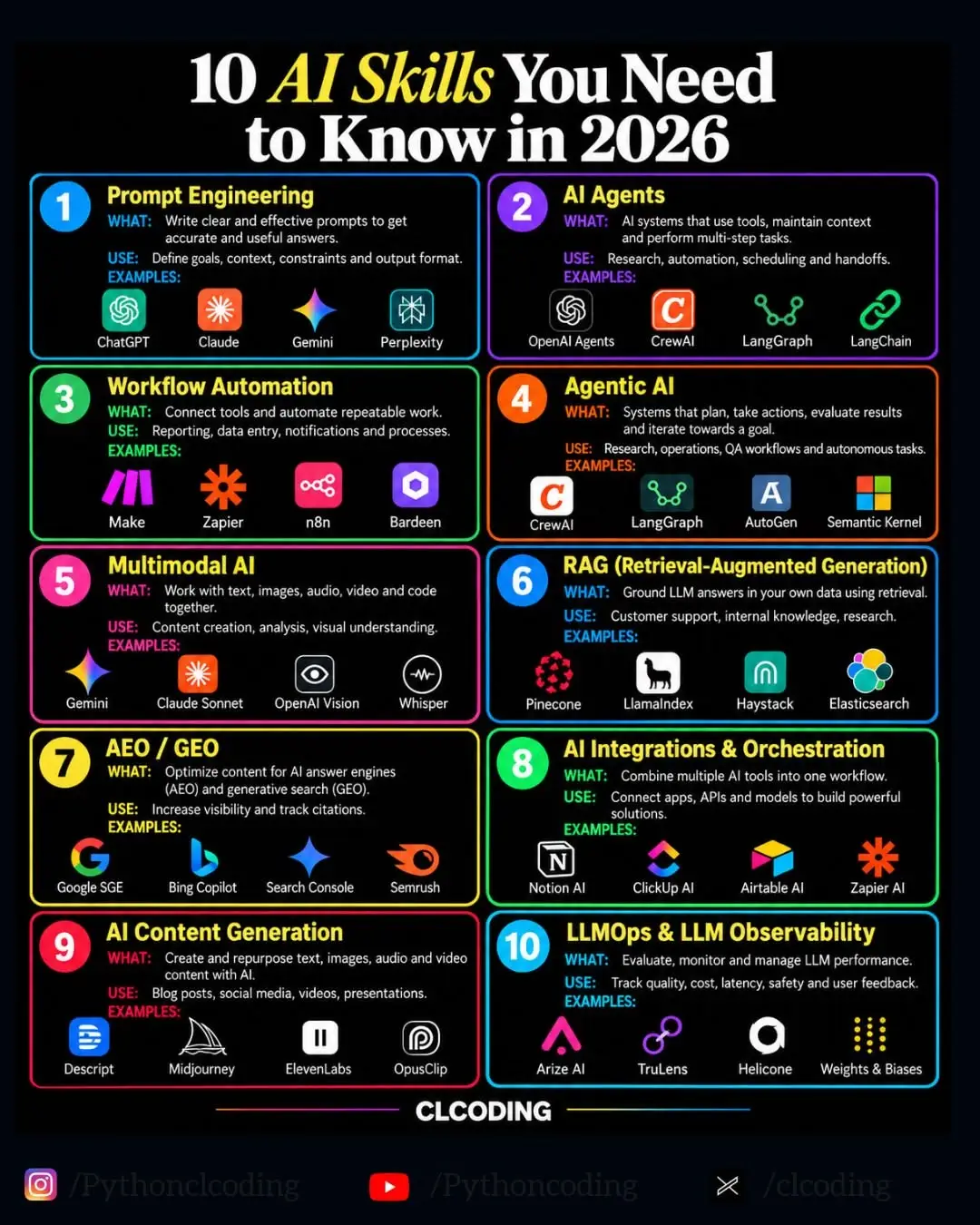
Artificial intelligence is changing how people work, do business, create content, analyze information, and solve problems. From AI-powered writing tools to intelligent agents that can perform complex tasks, AI technology is becoming an important part of many industries.
As businesses continue adopting AI, learning how to use and develop these technologies can create valuable career and business opportunities. Whether you are a student, freelancer, business owner, content creator, or technology professional, developing AI skills can help you remain competitive in the changing job market.
However, learning every AI tool is not necessary. The smarter approach is to focus on skills that solve real problems and can be applied to practical projects.
In this article, we explore the top AI skills to learn in 2026, why they matter, and how beginners can start developing them.
1. Prompt Engineering
Prompt engineering is the ability to write clear instructions that help AI systems produce useful and relevant results.
AI tools such as ChatGPT and other large language models respond to the instructions, information, and context users provide. Learning how to communicate effectively with these systems can improve the quality of their responses.
Prompt engineering involves:
- Writing clear and specific instructions.
- Providing relevant background information.
- Defining the expected output format.
- Breaking complex tasks into smaller steps.
- Reviewing and improving AI responses.
- Providing examples to guide the AI.
For example, instead of asking an AI tool to write an article, you could specify the target audience, topic, structure, tone, search intent, and required information.
Why learn it?
Prompt engineering is useful for content creation, research, marketing, education, customer service, and business operations. It is a practical starting point for people who want to use AI without learning programming.
2. AI Automation and Workflow Design
AI automation involves using artificial intelligence and connected software to reduce repetitive tasks and improve business processes.
Many businesses perform activities that consume time, including responding to customer inquiries, organizing information, preparing reports, and processing requests.
AI automation can help streamline these activities.
Examples include:
- Automatically organizing customer inquiries.
- Generating draft email responses.
- Summarizing documents.
- Extracting information from forms.
- Creating reports from business data.
- Connecting different business applications.
Tools such as Zapier, Make, and n8n can help users build automated workflows. AI services can also be integrated into these workflows to perform tasks involving language, classification, and decision support.
Why learn it?
Companies want to reduce unnecessary manual work and improve productivity. People who understand how to identify business problems and design reliable automation workflows can provide valuable services.
3. AI Agent Development
AI agents are systems that can use AI models, tools, and information sources to complete tasks with varying levels of independence.
Unlike a basic chatbot that mainly responds to questions, an AI agent may be designed to perform multiple connected actions.
For example, a customer-support agent might:
- Receive a customer question.
- Search an approved knowledge base.
- Identify the relevant information.
- Prepare a response.
- Escalate complicated requests to a human employee.
Learning AI agent development involves understanding tools, instructions, workflows, memory, permissions, and evaluation.
Useful technologies include Python, APIs, agent frameworks, and model platforms.
Why learn it?
AI agents are an important area of AI development. The 2026 Stanford AI Index identifies AI agents among the fastest-growing AI engineering skills in its cited LinkedIn data. <Link ref=”turn708057search12″ title=”Stanford AI Index Report 2026″/>.
4. Python Programming for AI
Python is one of the most useful programming languages for artificial intelligence, machine learning, and data science.
It has a large ecosystem of libraries and frameworks that help developers build AI applications.
Important Python concepts to learn include:
- Variables and data types.
- Functions and loops.
- Lists and dictionaries.
- File handling.
- APIs and JSON.
- Data processing.
- Basic object-oriented programming.
You can then explore AI-related libraries and frameworks such as:
- NumPy.
- Pandas.
- Scikit-learn.
- PyTorch.
- TensorFlow.
Why learn it?
Python provides a foundation for building AI applications, processing data, connecting AI models to software, and automating technical tasks.
Beginners should learn basic programming before attempting complicated machine learning projects.
5. Machine Learning
Machine learning is a branch of artificial intelligence that allows computers to identify patterns in data and use those patterns to make predictions or decisions.
Instead of programming every possible rule manually, developers train models using relevant data.
Common machine learning areas include:
Supervised learning: Models learn from labeled examples to predict outcomes.
Unsupervised learning: Models identify patterns and structures in data without predefined labels.
Reinforcement learning: Models learn through actions, feedback, and rewards.
Practical applications include fraud detection, product recommendations, demand forecasting, and predictive maintenance.
Why learn it?
Machine learning is important for people interested in data science, AI engineering, research, and technical development. It requires more technical preparation than basic AI tool usage, but it can provide a strong foundation for advanced AI careers.
6. Data Analysis and Visualization With AI
AI systems depend heavily on data. However, collecting information is not enough. Businesses also need people who can interpret data and turn it into useful decisions.
AI-assisted data analysis combines traditional analytical skills with tools that can help summarize information, identify patterns, and generate reports.
Important skills include:
- Microsoft Excel.
- SQL.
- Data cleaning.
- Statistical fundamentals.
- Data visualization.
- Dashboard creation.
- AI-assisted reporting.
Tools such as Power BI, Tableau, Excel, and Python can help analyze and present information.
For example, an analyst could use AI to assist with exploring sales data, identifying unusual changes, and preparing a summary for management.
Why learn it?
Data analysis is useful in finance, marketing, healthcare, education, retail, and many other industries. The ability to verify AI-generated analysis is just as important as knowing how to generate it.
7. Generative AI Content Creation
Generative AI can produce or assist with creating text, images, audio, video, and other digital content.
Content creators can use these tools to improve their production processes and explore new creative ideas.
Skills include:
- AI-assisted blog writing.
- Image generation.
- Video generation.
- Audio production.
- Scriptwriting.
- Content editing.
- Visual design.
- Content repurposing.
Popular tools include ChatGPT, image-generation platforms, Canva AI features, and AI-powered video editing applications.
For example, a digital marketer could use AI to develop campaign ideas, create initial drafts, generate visual concepts, and adapt content for different social media platforms.
Why learn it?
Businesses, creators, and marketing teams need digital content. Learning how to combine AI tools with human creativity can help people produce content more efficiently.
However, AI-generated material should be reviewed for accuracy, originality, quality, and copyright concerns before publication.
8. AI Chatbot Development
AI chatbots are software applications designed to communicate with users through natural language.
Businesses use chatbots to answer common questions, provide product information, assist customers, and direct users to relevant services.
Learning chatbot development involves:
- Understanding large language models.
- Designing conversation flows.
- Connecting APIs.
- Integrating knowledge bases.
- Building user interfaces.
- Testing chatbot responses.
- Managing privacy and security.
You can begin with no-code chatbot builders before moving into more advanced development using programming languages and APIs.
Why learn it?
Many businesses want to improve customer support and provide faster responses. Developers who can create reliable chatbots for specific industries may find opportunities in freelance work and software development.
9. Natural Language Processing (NLP)
Natural Language Processing is a field of AI that focuses on how computers understand, process, and generate human language.
It is used in many everyday technologies, including translation applications, voice assistants, search systems, text classification, and chatbots.
Important NLP concepts include:
- Text preprocessing.
- Tokenization.
- Sentiment analysis.
- Named entity recognition.
- Text classification.
- Language modeling.
- Embeddings.
Why learn it?
NLP is valuable for people interested in AI engineering, language technology, customer analytics, and building applications that work with large amounts of text.
It also provides a useful foundation for understanding how modern language models operate.
10. Computer Vision
Computer vision is a branch of AI that enables computers to interpret information from images and videos.
It allows software to identify objects, recognize patterns, analyze images, and extract visual information.
Applications include:
- Facial recognition systems.
- Medical image analysis.
- Manufacturing quality inspection.
- Traffic monitoring.
- Object detection.
- Retail inventory analysis.
- Agricultural image analysis.
Developers interested in this area can explore Python, OpenCV, PyTorch, and computer vision models.
Why learn it?
Computer vision has applications in healthcare, manufacturing, security, transportation, agriculture, and robotics. It is particularly useful for people interested in building AI systems that work with visual information.
11. AI Integration and API Development
AI integration is the process of connecting AI models and services to existing websites, applications, and business systems.
For example, a website developer could integrate an AI assistant into a website so visitors can ask questions about its products or services.
Important concepts include:
- Understanding APIs.
- Making HTTP requests.
- Working with JSON.
- Managing API keys securely.
- Connecting applications to AI models.
- Handling errors.
- Testing integrations.
- Managing usage costs.
Developers can use AI model APIs to add text generation, summarization, classification, and other capabilities to applications.
Why learn it?
Businesses often need AI added to tools they already use. Learning integration can help developers build practical solutions rather than simply demonstrating AI tools.
12. Retrieval-Augmented Generation (RAG)
Retrieval-Augmented Generation, commonly called RAG, is a technique that allows AI applications to retrieve relevant information from external sources before generating a response.
For example, a company could build an AI assistant that searches approved company documents before answering employee questions.
RAG systems commonly involve:
- Document processing.
- Text chunking.
- Embeddings.
- Vector databases.
- Information retrieval.
- Large language models.
- Response evaluation.
Why learn it?
RAG is useful for building AI assistants that need to work with specific documents, knowledge bases, and business information.
It can help make answers more relevant to a particular organization, although it does not guarantee accuracy. Retrieved sources and generated responses still need evaluation.
13. AI Security, Privacy, and Responsible AI
As AI becomes more widely used, organizations need people who understand the risks associated with these systems.
AI security and responsible AI involve protecting information, reducing misuse, identifying potential bias, and making sure AI systems are used appropriately.
Important areas include:
- Data privacy.
- Access control.
- Secure API management.
- Prompt injection awareness.
- AI output verification.
- Bias evaluation.
- Human oversight.
- Responsible data handling.
For example, a company should not automatically send confidential customer information to an unapproved AI service.
Why learn it?
Organizations need AI systems that are not only useful but also safe and trustworthy. The 2026 BCS AI Skills and Adoption Report highlights accuracy, trust, security, and data protection as major adoption challenges. <Link ref=”turn708057search1″ title=”BCS AI Skills and Adoption Report 2026″/>.
14. AI Product Management
AI product management combines business knowledge, customer research, technology understanding, and product development.
An AI product manager helps identify problems that AI can solve and coordinates the development of useful AI-powered products.
Key skills include:
- Understanding customer needs.
- Identifying valuable AI use cases.
- Defining product requirements.
- Working with developers.
- Evaluating AI performance.
- Managing product risks.
- Measuring business results.
Why learn it?
Building AI technology is only part of creating a successful product. Businesses also need people who can determine whether a proposed AI solution is useful, practical, and worth the investment.
15. Critical Thinking and AI Output Evaluation
One of the most important skills in the AI era is knowing how to evaluate what AI produces.
AI systems can generate incorrect information, misleading explanations, inaccurate calculations, and fabricated references.
Critical thinking helps users identify these problems instead of accepting every AI response as true.
Develop this skill by learning how to:
- Verify important facts.
- Compare information from reliable sources.
- Check calculations and assumptions.
- Identify unsupported claims.
- Evaluate sources and evidence.
- Recognize bias.
- Make decisions using human judgment.
The 2026 Coursera skills research emphasizes critical thinking and validation alongside growing AI adoption. <Link ref=”turn708057search8″ title=”Coursera Job Skills Report 2026″/>.
16. Which AI Skills Should Beginners Learn First?
If you are new to artificial intelligence, you do not need to learn all 15 skills immediately.
Start with skills that match your interests and career goals.
| Your goal | Skills to prioritize |
|---|---|
| Become a freelancer | Prompting, AI automation, content creation |
| Build AI applications | Python, APIs, RAG, AI agents |
| Work in data analysis | Excel, SQL, statistics, AI-assisted analysis |
| Become a digital marketer | AI content creation, automation, analytics |
| Build chatbots | Prompting, APIs, chatbot development |
| Enter machine learning | Python, mathematics, machine learning |
| Manage AI products | AI literacy, product management, critical thinking |
The best combination is usually one technical or practical AI skill supported by strong communication, problem-solving, and industry knowledge.
17. A 90-Day Plan to Learn AI Skills in 2026
A structured learning plan can help you move from basic knowledge to practical experience.
Days 1–30: Learn AI Fundamentals
Start by understanding how generative AI works at a high level.
Focus on:
- Understanding AI and machine learning.
- Learning effective prompting.
- Exploring AI writing and research tools.
- Practicing AI-assisted content creation.
- Learning how to verify AI-generated information.
Your goal should be to use AI confidently for everyday tasks.
Days 31–60: Choose a Specialization
Select one area based on your interests.
For example:
- AI automation.
- AI content creation.
- Data analysis.
- Chatbot development.
- Python programming.
- AI agent development.
Study the tools and concepts used in that area. Avoid jumping between unrelated technologies every few days.
Days 61–90: Build Practical Projects
Create projects that demonstrate what you can do.
Examples include:
- An automated email workflow.
- An AI-powered chatbot.
- A simple data analysis dashboard.
- A content planning assistant.
- A document question-answering application.
- An AI-assisted customer support workflow.
Document your work and explain the problem each project solves.
A portfolio of working projects can demonstrate your abilities to employers and potential clients more effectively than simply listing AI tools on your résumé.
18. Where Can You Learn AI Skills for Free?
Several educational platforms offer AI-related learning resources. Availability, course structure, and free access can vary.
Google AI resources: Explore introductory AI learning materials and practical AI concepts.
Microsoft Learn: Study AI fundamentals, cloud AI services, and related technologies.
IBM SkillsBuild: Explore learning resources covering artificial intelligence, data, and professional skills.
Elements of AI: A beginner-friendly educational resource that introduces fundamental AI concepts.
Kaggle Learn: Practice Python, data analysis, and machine learning through hands-on lessons.
Hugging Face: Explore tutorials and tools for machine learning, natural language processing, and open-source AI models.
When choosing a course, prioritize practical exercises and projects rather than collecting certificates without applying what you learn.
Frequently Asked Questions (FAQs)
1. What is the most valuable AI skill to learn in 2026?
There is no single best skill for everyone. AI automation, agent development, AI integration, data analysis, and prompt engineering are useful areas. The best choice depends on your career goals and the problems you want to solve.
2. Can I learn AI without coding?
Yes. You can start with prompt engineering, AI content creation, no-code automation, and AI productivity tools. However, learning Python and APIs can open additional opportunities in AI development.
3. How long does it take to learn AI skills?
Basic AI tool usage can be learned relatively quickly through regular practice. Developing advanced skills such as machine learning, agent development, and AI engineering usually requires more time, technical study, and project experience.
4. Which AI skill is best for freelancing?
AI automation, chatbot development, AI-assisted content services, video editing, and AI integration can be useful freelance specializations. Your ability to deliver a reliable solution matters more than simply knowing how to operate a tool.
5. Is prompt engineering still worth learning?
Yes. Clear instructions, useful context, and output evaluation remain important when working with AI systems. However, prompt engineering is strongest when combined with domain knowledge and practical skills.
6. Do I need a degree to work in artificial intelligence?
Not every AI-related job requires a university degree. Some opportunities emphasize practical skills, experience, certifications, and portfolios. Specialist research and engineering positions may require stronger academic and mathematical foundations.
7. Can AI skills help me make money online?
Yes. You can use AI-related skills to offer services such as content creation, workflow automation, chatbot development, data analysis, and website integration. Income depends on customer demand, service quality, competition, and your ability to find clients.
Conclusion
Artificial intelligence is creating new opportunities across technology, business, education, marketing, finance, and many other industries. Learning the right AI skills in 2026 can help you improve your productivity, develop new services, and prepare for changing career requirements.
Some of the most useful skills to consider include prompt engineering, AI automation, AI agent development, Python programming, machine learning, data analysis, chatbot development, AI integration, and responsible AI.
You do not need to master everything at once. Choose one skill that matches your interests, learn the fundamentals, and build practical projects that demonstrate your abilities.
The most valuable professionals will not simply know how to use AI tools. They will understand how to apply AI to real problems, evaluate its results, and combine technology with human creativity and judgment.
SEO Title: Top AI Skills to Learn in 2026: 15 Skills for the Future
Focus Keyword: top AI skills to learn in 2026
Slug: top-ai-skills-to-learn-in-2026
Meta Description: Discover the top AI skills to learn in 2026, including prompt engineering, AI automation, Python, machine learning, AI agents, and chatbot development.
Category: Artificial Intelligence
Tags: AI Skills, Artificial Intelligence, Learn AI, AI Automation, Prompt Engineering, Machine Learning, AI Agents, Python, Future Skills, Technology