
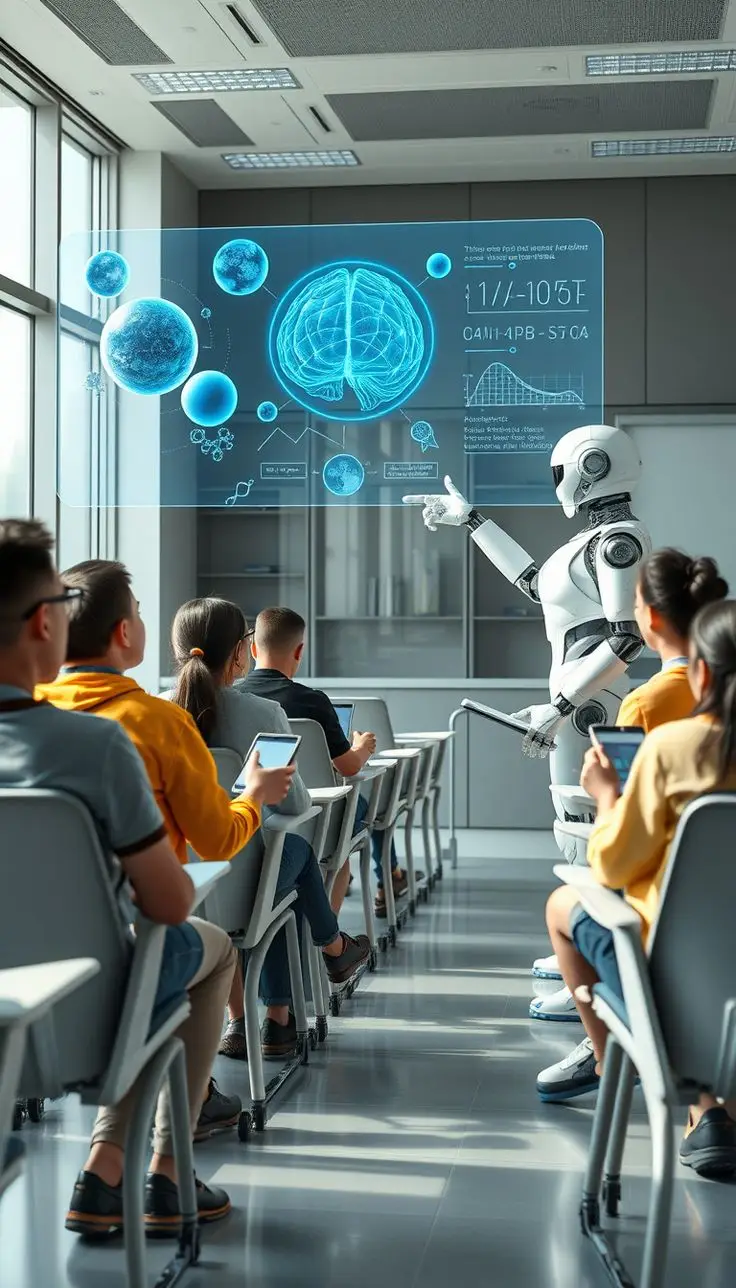
Artificial intelligence (AI) is transforming education in 2026 by making learning more personalized, improving teaching methods, supporting students with instant explanations, and helping schools manage administrative tasks. Students can now use AI-powered tutors to understand difficult subjects, while teachers can use AI to prepare lessons, develop assessments, and provide additional learning support.
However, AI is not simply replacing traditional education. It is changing how students learn, how teachers teach, and how educational institutions prepare learners for the future.
From personalized learning platforms to intelligent tutoring systems, AI is creating new opportunities for students and educators. In this article, we explore the major ways AI is transforming education in 2026, its benefits, challenges, and what the future may look like.
1. Personalized Learning for Every Student
One of the biggest changes AI is bringing to education is personalized learning.
In traditional classrooms, teachers often have to teach many students using the same lesson plan and schedule. However, students do not all learn at the same speed. Some understand a topic quickly, while others need additional explanations and practice.
AI-powered learning platforms can help address this challenge by adapting educational materials to individual needs.
For example, an AI learning system may:
- Identify topics a student finds difficult.
- Recommend additional exercises.
- Adjust question difficulty.
- Provide alternative explanations.
- Track learning progress.
- Suggest subjects that need more attention.
This allows students to receive learning support that better matches their abilities and progress.
2. AI-Powered Tutors and Homework Assistance
AI tutors are becoming useful educational tools because they can answer questions, explain concepts, and guide students through difficult topics.
Instead of waiting for the next lesson to ask a teacher for help, students can use AI tools to receive explanations whenever they need them.
For example, a student struggling with mathematics can ask an AI tutor to explain algebra using simple examples. If the first explanation is confusing, the student can request another explanation or work through practice questions.
AI tutors can support:
- Mathematics and science.
- Language learning.
- Computer programming.
- History and geography.
- Writing and grammar.
- Exam preparation.
The OECD’s 2026 Digital Education Outlook explains how conversational AI tutors can ask follow-up questions, remember difficulties during a learning session, and adapt explanations to a student’s progress. <Cite refs={[“turn869701search0″,”turn869701search12”]}/>
However, students should use AI to understand problems rather than simply copy completed homework answers.
3. Teachers Can Prepare Lessons More Quickly
Teachers spend considerable time preparing lessons, creating learning materials, writing questions, and organizing classroom activities.
AI can help reduce some of this workload by assisting with routine preparation tasks.
For example, teachers can use AI to:
- Generate lesson plan drafts.
- Create quizzes and practice questions.
- Simplify complex explanations.
- Develop classroom activities.
- Prepare presentation outlines.
- Suggest examples for difficult topics.
- Adapt learning materials for different ability levels.
A teacher preparing a science lesson about the solar system could use AI to generate discussion questions, create a simple explanation of planetary motion, and develop a short classroom quiz.
Teachers should still review AI-generated materials to ensure that they are accurate, appropriate, and aligned with the curriculum.
4. Faster Feedback and Student Assessment
Feedback helps students understand what they have done correctly and where they need improvement.
Traditionally, teachers may spend hours marking assignments and providing individual comments. AI can assist with some of these activities.
AI-powered assessment tools can help:
- Identify grammar mistakes.
- Check answers to structured questions.
- Highlight possible errors in calculations.
- Provide feedback on writing structure.
- Generate practice assessments.
- Organize student performance information.
For example, a student writing an essay may receive suggestions about grammar, organization, and clarity before submitting the final version.
However, AI should not make every important educational decision. Teachers need to review assessments, especially when grades affect students’ academic progress. AI can also struggle to evaluate creativity, originality, and context accurately. <Cite refs={[“turn869701search3″,”turn869701search0”]}/>
5. Making Education More Accessible
AI can help make educational resources more accessible to students with different learning needs, language backgrounds, and abilities.
Some AI-powered technologies can support students who face difficulties with traditional learning materials.
Examples include:
Text-to-speech: Converts written information into spoken words, helping students who prefer listening or have reading difficulties.
Speech-to-text: Converts spoken words into written text, supporting students who have difficulty typing.
Language translation: Helps learners understand educational materials written in other languages.
Automatic captions: Displays spoken words as text during videos and online lessons.
Simplified explanations: Helps students understand complicated information using more accessible language.
These tools can support inclusive education, although they should be selected carefully to meet individual accessibility requirements.
6. AI Is Changing Online Education
Online education has become an important part of modern learning. Students can access courses, tutorials, and educational resources without always attending a physical classroom.
AI is making online learning platforms more interactive.
For example, AI can help online learning systems:
- Recommend courses based on student interests.
- Generate personalized practice activities.
- Provide instant explanations.
- Identify learning difficulties.
- Summarize educational materials.
- Recommend additional resources.
This can make online learning more flexible and responsive.
Students can also use AI tools alongside platforms such as online course websites and virtual classrooms to organize their studies and review difficult subjects.
7. AI Helps Students Learn Languages
Language learning is another area experiencing significant changes because of AI.
AI-powered language applications can help students practice vocabulary, pronunciation, grammar, reading, and conversation.
For example, someone learning English can use an AI conversation tool to practice everyday discussions, receive grammar corrections, and learn alternative ways to express ideas.
AI language tools can provide:
- Conversation practice.
- Pronunciation feedback.
- Vocabulary exercises.
- Grammar explanations.
- Translation assistance.
- Reading comprehension activities.
This can make language practice more accessible outside traditional classrooms.
However, students should also practice speaking with real people to develop natural communication skills and understand cultural differences.
8. AI Is Supporting Teachers With Student Progress Analysis
Understanding student performance is important for improving educational outcomes.
AI-powered learning systems can analyze information such as quiz results, assignment performance, and learning activity to identify patterns.
For example, a teacher may notice that several students are struggling with the same mathematics topic. An AI-assisted system could help identify the common difficulty and suggest areas for additional instruction.
These insights may help teachers:
- Identify learning gaps.
- Recognize topics that need revision.
- Organize additional support.
- Monitor academic progress.
- Adjust lesson plans.
However, student data must be handled responsibly. Teachers should not rely on automated predictions without considering individual circumstances and other relevant evidence.
9. AI Is Transforming Educational Administration
AI is not only changing what happens inside classrooms. It is also helping educational institutions manage administrative activities.
Schools, colleges, and universities often handle large amounts of information and repetitive tasks.
AI can assist with:
- Organizing educational documents.
- Answering common student questions.
- Drafting administrative communications.
- Managing learning resources.
- Supporting admissions inquiries.
- Organizing timetables.
- Preparing institutional reports.
For example, an educational institution could use an AI-powered chatbot to answer common questions about course registration, application requirements, and academic schedules.
Human staff should remain responsible for important decisions and sensitive student matters.
10. AI Is Changing Research and Higher Education
Universities and research institutions are also using AI to support academic work.
Researchers can use AI tools to help organize information, summarize documents, explore research questions, and improve early drafts.
Students may use AI to:
- Understand academic concepts.
- Organize research notes.
- Generate ideas for research topics.
- Improve writing clarity.
- Analyze datasets.
- Debug programming code.
AI can make some research activities more efficient, but it does not replace the need to verify information, consult original research, and follow academic standards.
Researchers must also be careful about fabricated references, inaccurate summaries, and inappropriate use of confidential information.
11. AI Is Helping Students Prepare for Future Careers
The job market is changing as businesses adopt automation and AI-powered technologies.
Education systems are increasingly expected to prepare students for a world in which understanding AI will be useful across many professions.
Students can begin developing skills such as:
- AI literacy.
- Critical thinking.
- Data analysis.
- Digital communication.
- Programming.
- Problem-solving.
- Creativity.
- Responsible technology use.
For example, a business student may learn how AI supports market research, while a computer science student may explore machine learning and AI application development.
The objective should not be to teach students to depend entirely on AI. Instead, education should help them understand how to use technology while maintaining independent judgment.
12. The Challenges of Using AI in Education
Although AI offers many opportunities, its use in education also creates serious challenges.
Academic Dishonesty
Students can use AI to generate essays, solve assignments, and complete tasks without understanding the subject.
This makes it difficult for teachers to determine what students genuinely know.
Schools need clear policies explaining when AI assistance is acceptable and when students must complete work independently.
Incorrect Information
AI tools can produce inaccurate explanations, misleading facts, and fabricated references.
Students should learn to verify important information using textbooks, teachers, and reliable sources.
Data Privacy
Educational AI systems may process sensitive information about students, including personal details and academic performance.
Schools should carefully review how platforms collect, store, use, and protect student data.
Overdependence on Technology
If students use AI for every assignment, they may miss opportunities to develop writing, reasoning, memory, and problem-solving abilities.
AI should support learning rather than replace the effort required to understand a subject.
Unequal Access
Not every student has reliable internet access, suitable devices, or access to advanced AI tools.
If schools do not address these differences, AI could increase existing educational inequalities rather than reduce them.
UNESCO emphasizes the importance of human-centred AI in education, including privacy, inclusion, teacher preparation, and the protection of learners’ rights. <Cite refs={[“turn869701search2″,”turn869701search6”]}/>
13. How Students and Teachers Can Use AI Responsibly
To benefit from AI without becoming overly dependent on it, students and teachers should develop responsible habits.
Here are some practical recommendations:
- Use AI to understand difficult concepts instead of copying answers.
- Verify important facts using reliable educational sources.
- Follow school and university policies on AI assistance.
- Avoid uploading confidential personal or academic information into unapproved tools.
- Ask AI to explain its reasoning or provide examples.
- Complete independent practice without AI when necessary.
- Review AI-generated assignments and learning materials.
- Maintain meaningful interaction with teachers and classmates.
The goal is to make AI a learning partner rather than a replacement for independent thinking.
14. What Is the Future of AI in Education?
The future of education will likely involve greater collaboration between teachers, students, and AI-powered technologies.
We may see more advanced personalized tutoring systems, interactive learning environments, AI-supported career guidance, and educational platforms that respond to individual learning needs.
AI may also help teachers identify learning difficulties earlier and create educational materials for different student groups.
However, successful adoption will depend on more than advanced technology. Schools will need trained teachers, reliable infrastructure, clear policies, responsible data practices, and evidence that AI tools actually improve learning.
A recent OECD report stresses that educational AI should strengthen teaching and learning rather than replace human judgment and relationships. <Cite refs={[“turn869701search0″,”turn869701search1”]}/>
Frequently Asked Questions (FAQs)
1. How is AI changing education in 2026?
AI is changing education through personalized learning, intelligent tutoring, automated administrative support, faster feedback, language assistance, and AI-powered educational resources.
2. Can AI replace teachers in the future?
AI can assist with explanations, lesson preparation, and some assessment activities, but it cannot fully replace the human judgment, encouragement, classroom relationships, and guidance provided by teachers.
3. What are the benefits of AI for students?
AI can help students understand difficult topics, practice new skills, receive additional explanations, improve language learning, and access educational resources more flexibly.
4. What are the disadvantages of AI in education?
Some disadvantages include incorrect information, academic dishonesty, privacy concerns, overdependence on technology, and unequal access to digital resources.
5. Which AI tools can students use for learning?
Students can explore tools such as ChatGPT, language-learning applications, AI-powered study assistants, and educational platforms with personalized learning features. They should follow their institutions’ rules when using them.
6. Can AI help teachers save time?
Yes. AI can assist teachers with lesson preparation, quiz generation, educational content development, document organization, and routine administrative tasks. Teachers should review the results before using them.
7. Will AI make education cheaper?
AI may reduce some costs associated with content creation, tutoring support, and administration. However, technology infrastructure, subscriptions, training, maintenance, and data protection also involve expenses. Lower education costs are not guaranteed.
8. Why should students learn about artificial intelligence?
AI literacy helps students understand how modern technology works, recognize its limitations, use it responsibly, and prepare for careers in an increasingly digital economy.
Conclusion
Artificial intelligence is transforming education in 2026 by creating new ways for students to learn, teachers to teach, and educational institutions to operate. Personalized learning, AI tutors, automated feedback, language assistance, and educational administration are among the most important developments.
However, AI also introduces challenges involving academic integrity, data privacy, incorrect information, and overdependence on technology.
The best approach is to combine AI with effective teaching, independent thinking, creativity, and human interaction. AI should help students understand more, give teachers additional support, and make educational opportunities more accessible.
Ultimately, the future of education is not about replacing teachers with machines. It is about using technology responsibly to create better learning experiences for everyone.
SEO Title: How AI Is Transforming Education in 2026: Benefits and Challenges
Focus Keyword: how AI is transforming education in 2026
Slug: how-ai-is-transforming-education-in-2026
Meta Description: Discover how AI is transforming education in 2026 through personalized learning, AI tutors, smarter teaching, automated feedback, and new educational opportunities.
Category: Artificial Intelligence and Education
Tags: AI in Education, Artificial Intelligence, Education Technology, Personalized Learning, AI Tutors, Online Learning, Future of Education, Educational Technology