
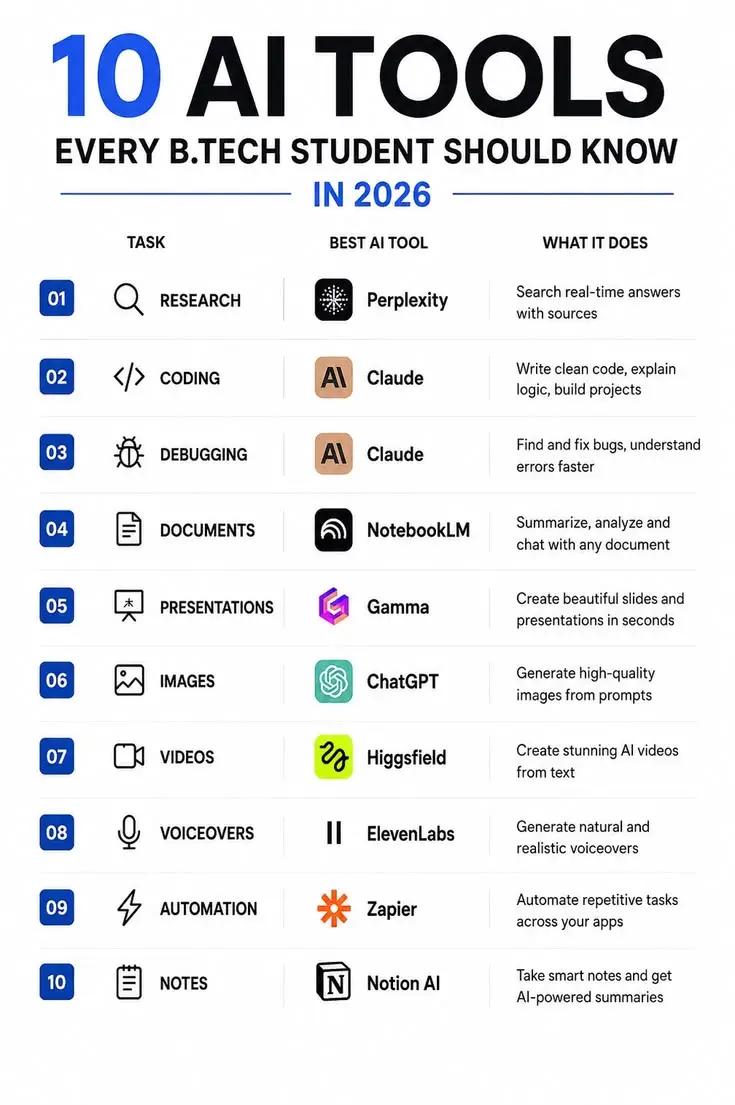
Introduction
Artificial Intelligence (AI) is transforming education in 2026. Students are increasingly using AI tools to understand difficult subjects, complete research, prepare for examinations, improve writing, and learn new skills.
With so many AI applications available, choosing the right one can be challenging. Some tools are designed for mathematics, while others specialize in research, writing, memorization, and personalized learning.
So, which AI tool is best for students?
ChatGPT is one of the best overall AI tools for students in 2026 because it offers assistance with multiple subjects and learning activities. However, several other AI tools can provide valuable support depending on a student’s academic needs.
Top 10 Best AI Tools for Students in 2026
1. ChatGPT – Best Overall AI Tool for Students
ChatGPT is an AI assistant developed by OpenAI. It helps students understand complicated topics, generate practice questions, summarize information, and improve their academic writing.
Students can use ChatGPT as a personal study assistant whenever they need help understanding a subject.
Main features:
- Explains difficult topics in simple language.
- Helps solve mathematics problems step by step.
- Creates examination practice questions.
- Summarizes study materials.
- Improves grammar and writing.
- Helps students learn programming.
- Creates revision notes and study plans.
ChatGPT is suitable for secondary school students, university students, and independent learners.
Website: https://chatgpt.com/
2. Google Gemini – Best for Research and Learning
Google Gemini is an AI assistant developed by Google. It helps students explore academic subjects, understand information, brainstorm ideas, and work with supported Google services.
It can provide explanations, help organize information, and support different learning activities.
Main features:
- Research assistance.
- Topic explanations.
- Writing support.
- Image understanding.
- Brainstorming.
- Integration with supported Google applications.
Gemini is a useful option for students who regularly work with Google products.
Website: https://gemini.google.com/
3. NotebookLM – Best for Studying Notes and PDFs
NotebookLM is an AI-powered research and study tool from Google. It allows students to work with their own learning materials, including supported documents and PDFs.
Instead of searching through lengthy notes manually, students can ask questions about their uploaded sources.
Main features:
- Summarizes lecture notes.
- Explains information from uploaded documents.
- Creates study guides.
- Generates questions based on sources.
- Helps organize research materials.
- Supports document-based learning.
NotebookLM is especially useful for university students who work with lengthy lecture notes, textbooks, and research documents.
Website: https://notebooklm.google.com/
4. Perplexity AI – Best for Academic Research
Perplexity AI is an AI-powered search and research assistant. It helps students find information and explore subjects through summarized answers with links to supporting sources.
It is particularly useful when students need to investigate a topic and identify websites or publications for further reading.
Main features:
- AI-powered research.
- Source-linked answers.
- Topic explanations.
- Information summaries.
- Follow-up research questions.
Students should still check the original sources and verify that they are reliable and suitable for academic work.
Website: https://www.perplexity.ai/
5. Claude – Best for Essay Writing and Document Analysis
Claude is an AI assistant developed by Anthropic. It is useful for understanding lengthy documents, organizing ideas, improving essays, and explaining complicated information.
Students can use it to review their writing and receive suggestions for improving clarity and structure.
Main features:
- Essay improvement.
- Document summarization.
- Detailed explanations.
- Brainstorming.
- Writing feedback.
- Programming assistance.
Claude is a useful choice for students who regularly complete research projects and written assignments.
Website: https://claude.ai/
6. Grammarly – Best for Grammar and Writing
Grammarly is an AI-powered writing assistant that helps students improve their written communication.
It identifies grammar mistakes, spelling errors, unclear sentences, and problems with tone.
Main features:
- Grammar correction.
- Spelling checks.
- Sentence improvement.
- Writing suggestions.
- Tone adjustments.
- Proofreading assistance.
Grammarly can help students improve essays, emails, reports, and other academic documents.
Website: https://www.grammarly.com/
7. Quizlet – Best for Memorization and Revision
Quizlet is a digital learning platform that helps students remember information through flashcards, practice tests, and other study activities.
It can be particularly helpful when preparing for examinations that require memorizing definitions, vocabulary, formulas, or important facts.
Main features:
- Digital flashcards.
- Practice tests.
- Vocabulary learning.
- Revision activities.
- Study materials.
Quizlet is a good choice for students who prefer interactive learning.
Website: https://quizlet.com/
8. Khanmigo – Best for Personalized Tutoring
Khanmigo is an AI-powered learning assistant developed by Khan Academy.
It is designed to guide students through problems and encourage them to understand concepts instead of simply providing answers.
Main features:
- Guided mathematics lessons.
- Learning assistance.
- Step-by-step explanations.
- Practice activities.
- Educational support.
It is particularly useful for students who need additional help understanding mathematics and other academic subjects.
Website: https://www.khanacademy.org/khan-labs
9. Wolfram Alpha – Best for Mathematics and Science
Wolfram Alpha is a computational knowledge engine that helps students solve mathematical and scientific problems.
It is especially useful for students studying subjects that involve equations, calculations, and mathematical concepts.
Main features:
- Algebra calculations.
- Calculus assistance.
- Equation solving.
- Scientific calculations.
- Mathematical explanations.
- Data-related calculations.
Students can use it to check calculations and understand mathematical problems.
Website: https://www.wolframalpha.com/
10. Canva AI – Best for Presentations and School Projects
Canva is a graphic design platform with AI-powered features that help students create visual learning materials.
It is useful for preparing school presentations, posters, diagrams, and educational graphics.
Main features:
- Presentation design.
- Poster creation.
- AI-assisted graphics.
- Image editing.
- Educational diagrams.
- Social media designs.
Canva is especially helpful for students who regularly complete visual assignments and presentations.
Website: https://www.canva.com/
Comparison of the Best AI Tools for Students
| AI tool | Best for |
|---|---|
| ChatGPT | General studying |
| Google Gemini | Research and learning |
| NotebookLM | Lecture notes and PDFs |
| Perplexity AI | Academic research |
| Claude | Essays and documents |
| Grammarly | Grammar correction |
| Quizlet | Memorization |
| Khanmigo | Personalized tutoring |
| Wolfram Alpha | Mathematics and science |
| Canva AI | Presentations and design |
Which AI Tool Should Students Choose?
The best AI tool depends on the student’s academic needs.
Here are some recommendations:
- For secondary school students: ChatGPT and Khanmigo.
- For university students: ChatGPT and NotebookLM.
- For mathematics students: Wolfram Alpha and ChatGPT.
- For science students: ChatGPT and Wolfram Alpha.
- For research projects: Perplexity and NotebookLM.
- For essay writing: Claude and Grammarly.
- For examination preparation: ChatGPT and Quizlet.
- For presentations: Canva AI.
Students do not need to pay for every AI application. They can begin with free access options and explore additional tools when necessary.
Benefits of Using AI Tools in Education
AI offers several benefits that can improve the learning experience.
1. Faster learning: AI can explain difficult concepts and provide examples that make complicated subjects easier to understand.
2. Better examination preparation: Students can generate practice questions, create revision notes, and test their knowledge.
3. Improved writing: AI writing assistants can help identify grammatical errors and improve sentence structure.
4. Personalized learning: Students can ask questions and request explanations based on their individual learning needs.
5. Better productivity: AI can help organize study schedules, summarize information, and reduce time spent on repetitive activities.
Disadvantages of Using AI for Studying
Although AI can improve education, students should understand its limitations.
- Incorrect information: AI sometimes produces inaccurate answers.
- Overdependence: Relying too heavily on AI can weaken independent thinking.
- Academic dishonesty: Submitting AI-generated work as entirely original may violate school rules.
- Privacy risks: Students should avoid sharing passwords, confidential documents, or sensitive personal information.
- Limited understanding: Copying answers without studying the explanations does not guarantee learning.
The best approach is to use AI to understand subjects, practice skills, and improve knowledge rather than simply copying answers.
How to Use AI Effectively for Studying
Students can get better results by asking clear questions and requesting explanations.
For example, instead of asking an AI tool to complete an entire assignment, use this prompt:
“Act as my personal study tutor. Explain this topic in simple English, provide practical examples, highlight the important points, and create 10 examination questions with answers. Help me understand the subject instead of simply giving me the answers.”
This approach encourages active learning and helps students develop independent problem-solving skills.
Conclusion
The best AI tool for students in 2026 depends on their learning goals. ChatGPT is an excellent all-round study assistant, NotebookLM is useful for studying lecture notes, Perplexity supports academic research, and Wolfram Alpha helps with mathematics and scientific calculations.
Other tools, including Gemini, Claude, Grammarly, Quizlet, Khanmigo, and Canva, provide additional support for different academic activities.
Students should choose tools that match their needs and use them responsibly. AI cannot replace the importance of studying, practicing, critical thinking, and understanding academic subjects.
When used correctly, artificial intelligence can become a valuable learning partner and help students prepare for future academic and professional opportunities.
Frequently Asked Questions (FAQs)
1. What is the best AI tool for students in 2026?
ChatGPT is one of the best overall AI tools because it supports explanations, research assistance, writing, mathematics, and examination preparation.
2. Which AI tool is best for students for free?
ChatGPT, Google Gemini, NotebookLM, and Perplexity offer free access options. Their available features and usage limits may vary.
3. Which AI is best for solving mathematics problems?
Wolfram Alpha and ChatGPT are useful for mathematics. They can help students understand equations, calculations, and problem-solving methods.
4. Can AI help students prepare for examinations?
Yes. Students can use AI to create practice questions, summarize notes, explain difficult topics, and develop revision schedules.
5. Which AI is best for university students?
ChatGPT, NotebookLM, Perplexity, and Claude are useful options for university students because they support research, document analysis, writing, and learning.
6. Is it safe for students to use AI?
Yes, when used responsibly. Students should protect their personal information, verify important answers, and follow their educational institution’s rules.