
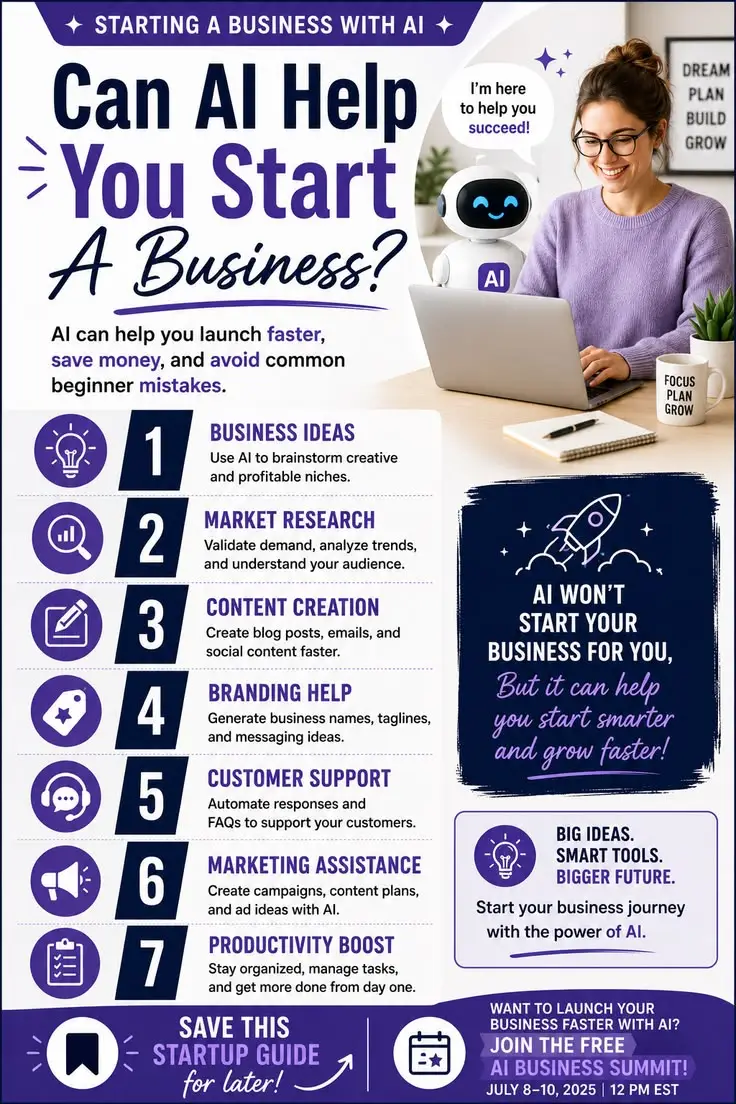
Artificial intelligence (AI) is becoming an important tool for businesses of all sizes. Whether you operate a small shop, an online store, a digital marketing agency, a restaurant, or a large company, AI can help you improve productivity, attract customers, manage daily operations, and increase profitability.
Many business owners spend hours completing repetitive tasks, responding to customer enquiries, creating marketing materials, and organizing information. AI tools can simplify many of these activities, giving business owners more time to focus on growth and customer satisfaction.
However, using AI successfully does not mean automating everything. The best approach is to identify areas where technology can solve real problems and introduce suitable tools gradually.
In this article, you will discover 12 practical ways to use AI to improve your business, examples of useful tools, and steps for getting started.
What Does It Mean to Use AI in Business?
Using AI in business means applying artificial intelligence technologies to improve how a company performs its activities.
AI tools can generate written content, analyze information, answer customer questions, organize documents, identify patterns, and automate repetitive processes.
For example, a clothing business can use AI to write product descriptions, create social media captions, analyze customer preferences, and prepare responses to common enquiries.
Instead of performing every activity manually, the business can use AI to complete routine work more efficiently while employees focus on important decisions.
1. Use AI to Improve Your Marketing Strategy
Marketing is essential for attracting customers, building brand awareness, and increasing sales. However, creating marketing campaigns regularly can require significant time and effort.
AI can help businesses develop marketing ideas, write promotional messages, understand customer interests, and prepare content for different platforms.
For example, you can use AI to:
- Generate social media content ideas.
- Write Facebook and Instagram captions.
- Create email marketing campaigns.
- Develop advertising headlines.
- Research customer interests.
- Prepare promotional content calendars.
A business selling beauty products could use AI to create a weekly marketing plan featuring product demonstrations, skincare tips, customer testimonials, and special offers.
Useful tools: ChatGPT, Canva, and HubSpot.
2. Use AI to Improve Customer Service
Customer service has a major influence on how people view a business. Customers want quick answers, helpful information, and solutions to their problems.
AI-powered chatbots and virtual assistants can help businesses respond to common enquiries automatically.
For example, an online store can use an AI chatbot to answer questions about:
- Product availability.
- Prices and payment methods.
- Delivery information.
- Return policies.
- Order tracking.
- Business opening hours.
This can reduce the workload on customer service employees and make basic support available outside normal working hours.
However, complicated complaints and sensitive customer issues should be transferred to a human representative.
Useful tools: Manychat, HubSpot, and supported AI chatbot platforms.
3. Use AI to Create High-Quality Content
Content marketing helps businesses attract potential customers through useful information.
However, regularly producing blog posts, website pages, product descriptions, and social media content can be challenging.
AI writing assistants can help businesses develop ideas and prepare initial drafts.
For example, a digital marketing agency can use AI to:
- Create blog post outlines.
- Draft website descriptions.
- Write promotional emails.
- Generate video scripts.
- Prepare social media captions.
- Rewrite content for different audiences.
AI-generated content should always be reviewed, fact-checked, and edited before publication. Adding original knowledge and real customer experiences can make it more valuable.
Useful tools: ChatGPT, Grammarly, and other AI writing assistants.
4. Use AI to Increase Sales
Every business wants to attract more customers and increase revenue. AI can support sales teams by helping them understand customer interests and manage potential buyers.
For example, a company can use AI to organize customer enquiries, identify promising leads, prepare sales proposals, and draft follow-up messages.
AI can also help online stores recommend products based on customer browsing or purchasing patterns.
Consider a customer who visits an online electronics store and views several laptops. A suitable recommendation system may suggest accessories or related products.
Businesses can use AI to:
- Organize sales leads.
- Prepare personalized offers.
- Draft follow-up messages.
- Analyze sales performance.
- Identify popular products.
- Support product recommendations.
AI can make the sales process more organized, but businesses should avoid sending excessive or unwanted promotional messages.
5. Use AI to Manage Business Finances
Financial management is one of the most important responsibilities of a business owner.
Companies need to understand their income, expenses, cash flow, and profitability. AI-powered financial software can help organize information and identify unusual patterns.
For example, AI can assist with:
- Categorizing business expenses.
- Organizing invoices.
- Preparing financial summaries.
- Identifying unusual transactions.
- Tracking payment reminders.
- Analyzing spending patterns.
A small business owner could use an AI assistant to summarize an expense spreadsheet and identify areas where spending has increased.
However, financial figures must be checked against reliable accounting records. AI should not replace qualified accounting or tax advice.
6. Use AI to Improve Employee Productivity
Employees often spend valuable time preparing documents, writing emails, organizing meetings, and searching for information.
AI tools can help reduce the time required for these activities.
For example, an employee can use AI to summarize a lengthy report, prepare a meeting agenda, or turn meeting notes into a list of responsibilities.
Businesses can also use AI to create training materials and explain internal procedures.
This allows employees to focus more on activities that require communication, problem-solving, and professional expertise.
Useful tools: Microsoft Copilot, ChatGPT, and Google Gemini.
7. Use AI to Improve Your Website
A business website is often the first place potential customers visit when learning about a company.
AI can help improve website content, customer experiences, and search engine optimization.
Businesses can use AI to:
- Generate website content ideas.
- Improve product descriptions.
- Draft frequently asked questions.
- Identify content gaps.
- Analyze website performance data.
- Suggest improvements to page structure.
For example, an online business can use AI to prepare clear product descriptions that explain features, benefits, and important purchasing information.
AI can also assist with SEO research, but it cannot guarantee that a website will rank first on Google.
8. Use AI to Understand Your Customers
Understanding customer needs is essential for developing products and services that people actually want.
AI can help businesses analyze customer feedback, reviews, surveys, and purchasing patterns.
For example, a restaurant can examine customer reviews to identify repeated complaints about delivery delays or food quality.
A clothing company can analyze customer feedback to understand which products, designs, and sizes are most popular.
These insights can help businesses improve their products and customer experiences.
AI should analyze information responsibly, with appropriate protection for customer privacy.
9. Use AI to Automate Repetitive Business Tasks
Many business activities are repetitive and do not require employees to complete every step manually.
AI and workflow automation tools can connect different applications and simplify everyday processes.
Examples include:
- Sending appointment reminders.
- Organizing customer enquiries.
- Preparing routine email drafts.
- Updating spreadsheets.
- Generating weekly reports.
- Sending order confirmations.
- Organizing incoming documents.
For instance, when a customer submits an enquiry through a website, an automated workflow could record the information in a customer management system and notify the sales team.
Useful tools: Zapier, Make, and n8n.
10. Use AI to Improve Inventory Management
Businesses that sell physical products need to maintain appropriate stock levels.
Too little inventory can result in missed sales, while excessive inventory can tie up money and increase storage costs.
AI-powered inventory systems can analyze previous sales, seasonal demand, and stock information to help businesses plan purchases.
For example, a supermarket can use historical sales information to estimate which products may experience higher demand during festive periods.
AI can also help identify slow-moving products and generate low-stock alerts.
These systems support inventory planning, although managers should review forecasts before making major purchasing decisions.
11. Use AI for Competitor and Market Research
Understanding competitors and market trends can help businesses identify opportunities and improve their strategies.
AI research tools can help organize publicly available information, compare product features, summarize customer reviews, and identify common market trends.
For example, a new online clothing business could research:
- Popular product categories.
- Competitor pricing.
- Customer complaints.
- Marketing strategies.
- Common product features.
- Potential market opportunities.
AI can make research faster, but business owners should verify important findings using reliable and current sources.
12. Use AI to Develop New Business Ideas
AI can also help entrepreneurs discover new opportunities and develop existing ideas.
If you want to start a business but do not know which direction to take, you can use AI to brainstorm possible products, services, and customer groups.
For example, you could ask an AI assistant to identify business opportunities in digital marketing, online education, e-commerce, or professional services.
AI can help you:
- Generate business ideas.
- Develop business plans.
- Identify potential customers.
- Create pricing strategies.
- Prepare marketing plans.
- Analyze possible business risks.
Remember that an AI-generated business idea is not proof of market demand. Research and customer feedback are still necessary.
Best AI Tools to Improve Your Business
Choosing the right AI tools depends on the type of work you want to improve.
Here are some popular options:
| AI Tool | How It Helps |
|---|---|
| ChatGPT | Writing, research, brainstorming, and analysis |
| Google Gemini | Research, writing, and productivity |
| Microsoft Copilot | Workplace productivity and document assistance |
| Canva | Marketing designs and visual content |
| Zapier | Connecting apps and automating workflows |
| Make | Building visual automation workflows |
| HubSpot | Customer management, sales, and marketing |
| Grammarly | Improving writing and communication |
You do not need to subscribe to every tool. Start with one or two that address your most important business challenges.
How to Start Using AI in Your Business
If you have never used AI in your business, you can begin with a simple approach.
Step 1: Identify your biggest business problem.
Determine what consumes the most time or creates unnecessary expenses. It could be customer communication, marketing, administration, or financial organization.
Step 2: Choose an appropriate AI tool.
Find a tool that addresses the problem you identified. Avoid paying for complicated software before understanding what your business actually needs.
Step 3: Test AI on a small task.
For example, use ChatGPT to prepare five social media captions or summarize a weekly business report.
Step 4: Review the results.
Check whether AI improves accuracy, saves time, or makes the process easier. Correct mistakes and improve your instructions.
Step 5: Train your employees.
Show employees how to use approved AI tools and explain which information should never be entered into them.
Step 6: Measure the benefits.
Compare performance before and after introducing AI. Monitor time saved, customer satisfaction, operating expenses, and sales performance.
Step 7: Expand gradually.
Once one AI workflow is working successfully, consider introducing another.
Recent small-business guidance similarly recommends starting with one specific business challenge, testing a manageable solution, and expanding based on measurable results. <Link ref=”turn347096search1″ title=”Business Growth West Midlands – Practical AI Guide”/>.
Common Mistakes to Avoid When Using AI
Although AI offers many opportunities, businesses should avoid several mistakes.
1. Automating everything: Not every business activity needs AI. Personal relationships and complicated decisions often require human involvement.
2. Trusting every AI response: AI can produce inaccurate information. Always verify important facts, prices, figures, and business policies.
3. Ignoring customer privacy: Never share passwords, payment card details, confidential financial records, or sensitive customer information with unapproved AI tools.
4. Buying too many subscriptions: Start with tools that solve specific problems rather than spending money on software you rarely use.
5. Publishing unedited AI content: Review AI-generated articles, advertisements, and customer messages to ensure they represent your business accurately.
6. Failing to measure results: A tool is only valuable when it produces a meaningful improvement.
Frequently Asked Questions (FAQs)
1. How can I use AI to improve my business?
You can use AI to improve marketing, customer service, sales, financial organization, website content, inventory management, and daily business operations.
2. What is the best AI tool for business owners?
ChatGPT is a useful general-purpose option for writing, research, planning, and analysis. Other tools, such as Zapier, Canva, HubSpot, and Microsoft Copilot, are useful for specific business activities.
3. Can AI help a small business grow?
Yes. AI can help small businesses save time, improve customer communication, create marketing materials, and organize operations. Results depend on choosing the right tools and using them effectively.
4. Can AI increase business profits?
AI may help improve profitability by reducing certain costs, supporting sales, and increasing productivity. However, profit is not guaranteed and depends on implementation costs, customer demand, and business performance.
5. Do I need technical skills to use AI in business?
No. Many AI tools are designed for ordinary users. You can begin with simple instructions and gradually learn how to create more advanced workflows.
6. Is AI safe for business use?
AI can be used responsibly when businesses choose appropriate platforms, protect confidential information, review generated content, and maintain human oversight.
Conclusion
AI offers businesses practical opportunities to improve productivity, attract customers, reduce repetitive work, and make more informed decisions. From marketing and customer service to financial management and inventory planning, artificial intelligence can support many areas of business operations.
You do not need to transform your entire company overnight. Start by identifying one problem, choose a suitable AI tool, and test whether it improves the way you work.
The businesses that benefit most from AI will not necessarily be those using the largest number of tools. They will be the ones that understand their customers, apply technology to genuine problems, and combine AI capabilities with human experience.
SEO Title: How to Use AI to Improve Your Business: 12 Practical Ways
Focus Keyword: How to use AI to improve your business
URL Slug: how-to-use-ai-to-improve-your-business
Meta Description: Learn how to use AI to improve your business through marketing, customer service, sales, automation, financial management, and productivity.
Category: Artificial Intelligence / Business
Tags: AI for Business, Business Growth, Artificial Intelligence, AI Tools, Business Automation, Small Business Tips, Digital Transformation