
Artifi cial intelligence (AI) is transforming the way people work, learn, communicate, and run businesses. AI can write articles, generate images, analyze information, answer questions, and automate repetitive tasks. However, there are important human abilities that current AI systems cannot fully reproduce.
The future is not necessarily about humans competing against AI. It is about developing skills that allow people to work alongside technology while offering qualities that machines cannot genuinely provide.
Research from MIT Sloan highlights five important human capability groups: empathy, human connection, judgment, creativity, and hope or leadership. These capabilities help explain why human contributions remain valuable even as AI becomes more advanced.
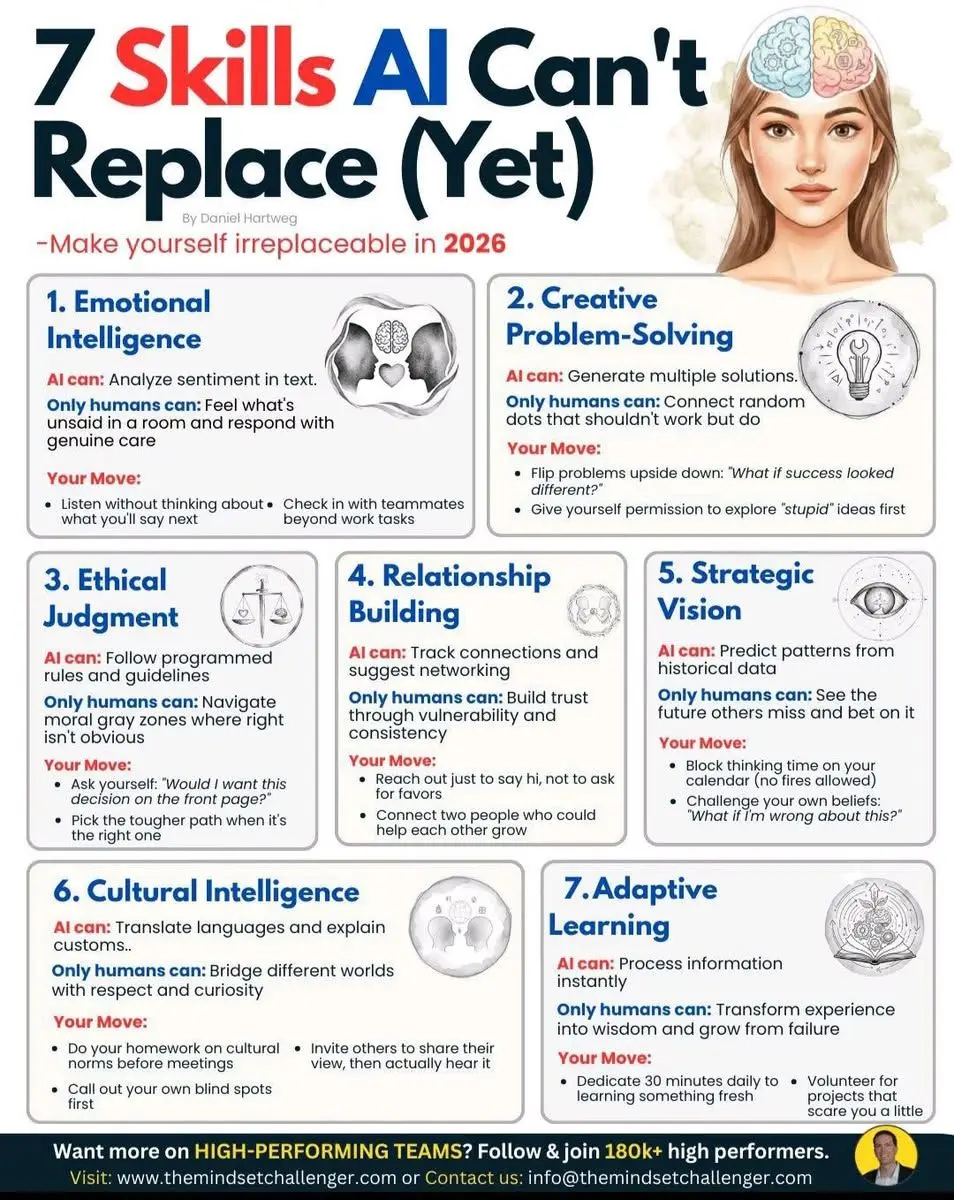
Here are seven valuable human skills to develop in the age of AI.
1. Emotional Intelligence and Empathy
Emotional intelligence is the ability to recognize, understand, and manage emotions while responding appropriately to other people’s feelings.
Empathy involves understanding another person’s experiences and showing genuine concern for their situation.
Although AI can recognize emotional language and generate supportive responses, it does not experience human emotions or form personal relationships in the same way people do.
For example, imagine a friend losing a loved one. An AI assistant can suggest comforting words, but a human friend can provide genuine companionship, shared experiences, and personal emotional support.
Emotional intelligence is important in:
- Healthcare and caregiving.
- Teaching and education.
- Customer service.
- Counselling and social work.
- Leadership and management.
- Conflict resolution.
How to develop this skill: Practice active listening, pay attention to other people’s feelings, communicate respectfully, and learn to respond calmly during difficult situations.
2. Critical Thinking and Problem-Solving
Critical thinking is the ability to examine information, question assumptions, identify mistakes, and reach reasonable conclusions.
AI can process large amounts of information quickly, but its answers are not always correct. It can misunderstand a question, produce misleading information, or overlook important details.
Humans must therefore evaluate AI-generated information before relying on it.
For example, a business owner may ask AI to recommend a marketing strategy. However, the owner still needs to consider the company’s budget, customers, competitors, and business goals before making a decision.
Critical thinking is particularly important when:
- Making business decisions.
- Evaluating information online.
- Solving complicated problems.
- Comparing different opportunities.
- Identifying misinformation.
- Managing unexpected situations.
How to develop this skill: Read widely, ask questions, compare different sources, examine evidence, and practice solving problems without immediately depending on AI.
3. Creativity and Imagination
Creativity is the ability to develop original ideas, explore possibilities, and find new ways to solve problems.
AI can generate stories, designs, music, advertisements, and other creative outputs. However, human creativity involves personal experiences, emotions, cultural understanding, imagination, and individual intentions.
For example, an entrepreneur may identify an opportunity that does not yet exist in the market because of personal experience with a particular problem.
AI can help develop the idea, but the human entrepreneur provides the personal vision and decides how to turn it into something meaningful.
Creativity is important in:
- Business innovation.
- Art and design.
- Writing and storytelling.
- Product development.
- Advertising.
- Entrepreneurship.
How to develop this skill: Explore new experiences, read books, experiment with ideas, solve creative challenges, and learn to approach problems from different perspectives.
4. Leadership and Decision-Making
Leadership is the ability to guide people, establish goals, inspire teams, and take responsibility for important decisions.
AI can analyze business information, prepare reports, and recommend possible actions. However, effective leadership requires understanding people, building trust, managing disagreements, and accepting responsibility for decisions.
Consider a company experiencing financial difficulties. AI may analyze expenses and suggest ways to reduce costs, but a human leader must consider employees, customers, long-term objectives, and the consequences of different choices.
Important leadership abilities include:
- Motivating employees.
- Managing teams.
- Making difficult decisions.
- Resolving disagreements.
- Building trust.
- Taking responsibility.
How to develop this skill: Volunteer to lead projects, practice communication, learn to manage disagreements, and take responsibility for your decisions.
5. Communication and Relationship Building
Communication is more than exchanging information. It involves understanding people, interpreting situations, expressing ideas clearly, and developing meaningful relationships.
AI can generate emails, translate languages, and respond to customer questions. However, human relationships often depend on trust, shared experiences, social awareness, and personal interaction.
For example, a salesperson may use AI to prepare a presentation, but successfully negotiating with a customer requires understanding their concerns and building confidence.
Strong communication skills are valuable in:
- Business negotiations.
- Customer relationships.
- Team collaboration.
- Teaching and mentoring.
- Public speaking.
- Networking.
How to develop this skill: Practice speaking clearly, listen carefully, ask meaningful questions, respect different opinions, and learn how to explain complicated ideas simply.
6. Ethical Judgment and Moral Responsibility
Ethical judgment is the ability to distinguish between acceptable and unacceptable actions while considering fairness, honesty, responsibility, and the possible consequences of decisions.
AI can follow instructions and apply predefined rules, but it may struggle with situations involving conflicting human values or complicated moral questions.
For example, a business might use AI to analyze job applications. However, humans must ensure that the recruitment process is fair and does not discriminate against qualified applicants.
Ethical judgment is important when:
- Protecting customer privacy.
- Making employment decisions.
- Managing sensitive information.
- Handling financial responsibilities.
- Preventing discrimination.
- Using AI responsibly.
How to develop this skill: Learn about professional ethics, respect people’s rights, consider the consequences of your actions, and take responsibility for important decisions.
7. Adaptability and Resilience
Adaptability is the ability to adjust when circumstances change, while resilience is the ability to recover from difficulties and continue working toward important goals.
Technology, industries, and job requirements change constantly. People who can learn new skills and adjust to unfamiliar situations are better prepared for these changes.
For example, a graphic designer who learns to use AI design tools can combine traditional design knowledge with new technology to improve productivity and explore additional creative opportunities.
Adaptability is valuable because:
- New technologies continue to emerge.
- Job requirements change.
- Businesses face unexpected challenges.
- Customers develop new expectations.
- Employees need to learn new tools.
- Industries experience economic changes.
How to develop this skill: Stay curious, learn continuously, accept constructive feedback, experiment with new technology, and treat challenges as opportunities to improve.
Why Are Human Skills Becoming More Important in the Age of AI?
As AI becomes capable of completing more routine tasks, employers and businesses increasingly need people who can provide judgment, leadership, creativity, and meaningful human interaction.
For example, AI may help a manager prepare a business report, but the manager must understand the company’s circumstances and decide what actions should follow.
Similarly, AI can generate marketing content, but human marketers still need to understand customers, develop brand identities, and make strategic decisions.
A Harvard Business School article also emphasizes the continuing importance of emotional intelligence, human relationships, ethical reasoning, and judgment in an AI-powered workplace.
The goal should not be to reject AI. Instead, people should learn to use it while strengthening their own abilities.
How Can You Develop Human Skills That AI Cannot Easily Replace?
You do not need to develop all seven skills at once. You can improve them gradually through everyday activities.
Here are practical steps:
- Read regularly: Reading books and informative articles improves understanding and critical thinking.
- Communicate with people: Practice listening, explaining ideas, and building relationships.
- Solve problems independently: Try to understand a problem before asking AI for an answer.
- Take responsibility: Make decisions and learn from their consequences.
- Explore creative activities: Try writing, designing, brainstorming, and developing new ideas.
- Learn continuously: Keep improving your professional and technical knowledge.
- Use AI as a learning partner: Ask AI to explain difficult topics, challenge your assumptions, and provide feedback rather than simply completing every task for you.
Frequently Asked Questions (FAQs)
1. What are the seven human skills AI cannot replace?
Seven important skills are emotional intelligence, critical thinking, creativity, leadership, communication, ethical judgment, and adaptability.
2. Can AI replace human creativity?
AI can generate creative content, but human creativity involves personal experiences, imagination, intentions, and the ability to develop ideas based on individual perspectives.
3. Why is emotional intelligence important in the age of AI?
Emotional intelligence helps people understand feelings, build trust, manage relationships, and handle difficult social situations.
4. Which human skill is most important for the future?
There is no single answer. Critical thinking, adaptability, communication, and emotional intelligence are particularly valuable because they help people work effectively in changing environments.
5. Can AI replace human leadership?
AI can support leaders by analyzing information and recommending actions, but human leadership involves accountability, relationships, motivation, and responsibility.
6. Should students learn AI or human skills?
Students should learn both. AI knowledge can improve productivity, while human skills help them think independently, communicate effectively, solve problems, and adapt to new opportunities.
7. How can I protect my career from AI?
Develop skills that complement AI, learn how to use modern technology, strengthen your professional expertise, and continue improving your communication, creativity, judgment, and adaptability.
Conclusion
AI is changing the world, but human skills remain essential. Emotional intelligence, critical thinking, creativity, leadership, communication, ethical judgment, and adaptability are important abilities that current AI systems cannot fully reproduce.
People who develop these skills while learning how to use AI effectively can become more valuable in the workplace and better prepared for future opportunities.
Rather than viewing artificial intelligence as an enemy, consider it a tool that can help you become more productive. Let AI assist with repetitive activities while you focus on the qualities that make human contributions meaningful.