
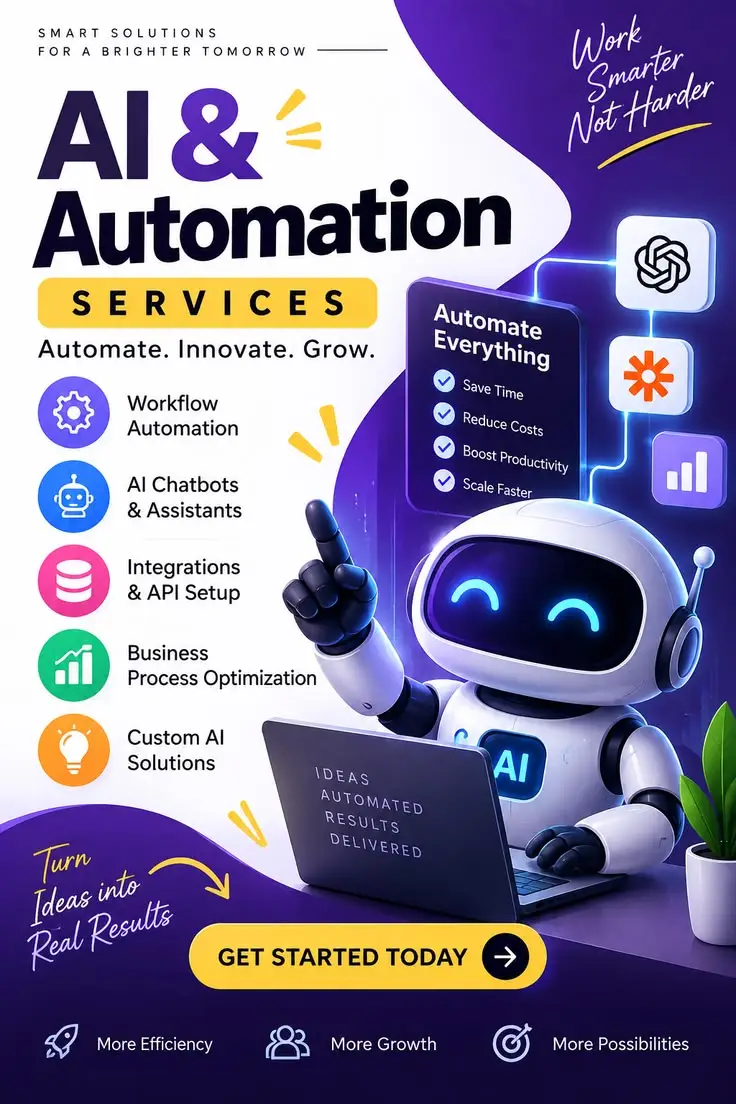
Artificial intelligence (AI) is changing the way businesses operate. From small startups to large corporations, companies are using AI automation to complete tasks faster, improve customer experiences, reduce operating expenses, and increase productivity. Instead of spending hours on repetitive activities, employees can use AI-powered systems to handle routine work while focusing on more important business goals.
AI automation is no longer limited to large technology companies. Small businesses, online stores, marketing agencies, restaurants, financial institutions, and service providers can also benefit from it.
But how exactly does AI automation help businesses, and why is it becoming increasingly important?
What Is AI Automation in Business?
AI automation is the use of artificial intelligence to perform tasks and manage business processes that would otherwise require significant human effort.
Traditional automation follows predefined instructions. AI automation goes further by using technologies such as machine learning, natural language processing, and predictive analytics to interpret information, identify patterns, and support more flexible workflows.
For example, a traditional automated system might send the same confirmation email whenever a customer places an order. An AI-powered system could also understand customer questions, identify an order-related problem, prepare a relevant response, and direct complicated issues to a human employee.
Businesses use AI automation in customer service, marketing, sales, accounting, inventory management, recruitment, and many other departments.
1. AI Automation Saves Time
One of the biggest advantages of AI automation is that it reduces the time employees spend on repetitive activities.
Many businesses perform tasks such as answering common emails, organizing documents, entering customer information, preparing reports, and scheduling appointments. Completing these activities manually can consume valuable working hours.
AI-powered tools can handle parts of these processes automatically.
For example, a company can use AI to:
- Organize incoming emails.
- Summarize lengthy documents.
- Prepare routine business reports.
- Schedule meetings and appointments.
- Extract information from invoices.
- Draft responses to common questions.
This allows employees to concentrate on responsibilities that require creativity, communication, and professional judgment.
2. It Reduces Business Operating Costs
Running a business involves several expenses, including employee salaries, administration, marketing, customer support, and daily operations.
AI automation can help reduce unnecessary expenses by improving how these activities are performed.
For instance, an online store can use automated customer support to answer frequently asked questions instead of requiring employees to respond manually to every simple enquiry.
Similarly, an accounting department can use AI-powered software to organize invoices and identify unusual transactions, reducing the time spent on manual bookkeeping.
However, AI automation does not eliminate every business expense. Companies still need to pay for software, maintenance, employee training, and human supervision.
3. It Improves Customer Service
Customers expect businesses to respond quickly when they have questions or problems. Slow responses can lead to frustration and lost sales.
AI automation helps companies improve customer service through chatbots, virtual assistants, automated email responses, and customer support systems.
For example, a business can introduce an AI chatbot on its website to answer questions about:
- Product prices.
- Delivery information.
- Payment methods.
- Return policies.
- Business opening hours.
- Order tracking.
Some systems can provide support around the clock, even when employees are unavailable.
When a customer has a complicated problem, the chatbot should be able to transfer the conversation to a human representative.
4. AI Makes Marketing More Effective
Marketing is important for attracting customers and increasing sales, but managing campaigns manually can take considerable time.
AI automation helps businesses plan, organize, and improve marketing activities.
Companies can use AI-powered tools to analyze customer interests, identify audience groups, prepare marketing content, and automate email campaigns.
For example, an online business can use customer activity to recommend products that may interest individual shoppers.
AI can also help marketing teams:
- Generate content ideas.
- Prepare social media captions.
- Analyze campaign performance.
- Organize email subscribers.
- Schedule marketing messages.
- Identify customer engagement patterns.
Businesses should still review AI-generated content to ensure that it is accurate, relevant, and consistent with their brand.
5. It Helps Businesses Make Better Decisions
Businesses generate large amounts of information through sales, customer interactions, website traffic, and financial transactions.
Analyzing all this information manually can be difficult, especially for companies with many customers.
AI automation can examine large datasets and identify patterns that help managers understand business performance.
For example, an online retailer can analyze previous sales to identify popular products, estimate future demand, and plan inventory purchases.
AI can also help businesses:
- Understand customer behavior.
- Monitor sales performance.
- Identify changing market trends.
- Estimate future product demand.
- Discover operational problems.
- Compare business performance over time.
These insights support decision-making, although important decisions should still involve human judgment and reliable information.
6. It Improves Employee Productivity
AI automation does not have to replace employees to create value. In many businesses, it works as an assistant that helps people complete their responsibilities more efficiently.
Employees can use AI to prepare documents, summarize meetings, research information, organize schedules, and complete repetitive administrative work.
For example, a sales representative can use an AI assistant to summarize previous customer conversations before making a follow-up call.
This reduces preparation time and allows the employee to focus on building customer relationships.
When implemented properly, AI can help businesses make better use of their existing workforce.
7. It Helps Manage Inventory and Supply Chains
Inventory management is particularly important for retail businesses, supermarkets, warehouses, and manufacturing companies.
Poor inventory management can lead to two major problems: running out of popular products or purchasing more stock than customers need.
AI-powered inventory systems can analyze historical sales, seasonal demand, and current stock levels to help businesses plan purchases.
Some systems can also generate alerts when inventory becomes low.
For example, an online clothing store can use AI to identify which products are selling quickly and estimate when additional stock may be required.
This can improve stock planning, reduce waste, and support smoother business operations.
8. It Improves Financial Management
Financial management is essential for every business. Companies need to monitor expenses, prepare financial reports, process invoices, and keep accurate records.
AI automation can support these activities by organizing financial information and identifying unusual transactions.
Examples include:
- Extracting information from invoices.
- Categorizing business expenses.
- Matching payments with invoices.
- Preparing financial summaries.
- Identifying unusual transactions.
- Sending payment reminders.
AI can also help financial teams recognize patterns that may indicate errors or possible fraud.
However, businesses should not rely entirely on AI for financial decisions. Important transactions, tax matters, and financial reports require appropriate human review.
9. It Supports Recruitment and Human Resources
Hiring employees involves reviewing applications, organizing interviews, communicating with candidates, and maintaining employee records.
AI automation can help human resource departments manage some of these responsibilities.
For example, recruitment software can organize applications, identify relevant qualifications, and help schedule interviews.
AI can also assist with employee onboarding by preparing training materials, answering routine workplace questions, and organizing documentation.
However, recruitment decisions should involve human oversight. Businesses must check for unfair bias, protect applicants’ personal information, and avoid allowing automated systems to make important employment decisions without proper review.
10. It Helps Small Businesses Compete With Larger Companies
Small businesses often operate with limited budgets and smaller teams. As a result, they may struggle to manage marketing, customer support, administration, and daily operations simultaneously.
AI automation can help small businesses increase their capacity without immediately hiring additional employees for every task.
For example, a small digital marketing agency can use AI to prepare content drafts, organize client enquiries, generate reports, and schedule social media posts.
A small online store can automate order notifications, customer communication, and basic inventory alerts.
This gives smaller companies access to useful capabilities that were previously more difficult or expensive to manage.
Examples of AI Automation Tools Businesses Can Use
Several AI-powered platforms can help businesses automate different activities.
1. ChatGPT: Businesses can use ChatGPT to brainstorm ideas, draft emails, summarize documents, prepare marketing content, and assist with research.
2. Zapier: This platform connects different applications and automates workflows, such as transferring information between forms, spreadsheets, and customer management systems.
3. Make: Make allows businesses to build automated workflows connecting different software applications.
4. Microsoft Copilot: Businesses can use Copilot to assist with writing, information analysis, productivity, and work across supported Microsoft applications.
5. Manychat: This platform helps businesses automate conversations and marketing interactions through supported messaging and social media channels.
6. HubSpot: HubSpot provides customer relationship management, marketing, sales, and customer service tools, including automation features.
The best tool depends on the business’s size, budget, existing software, and specific requirements.
What Are the Challenges of AI Automation?
Although AI automation offers many benefits, businesses should understand its limitations before adopting it.
Some important challenges include:
Data privacy: AI systems may process sensitive customer or company information. Businesses must protect this information and follow applicable privacy requirements.
Implementation costs: Some automation platforms require subscription payments, technical setup, training, and ongoing maintenance.
Incorrect information: AI systems can sometimes generate inaccurate answers or misunderstand customer requests. Important outputs need to be checked.
Employee training: Workers need to understand how to use AI tools properly and when human judgment is necessary.
Overdependence on automation: Businesses should maintain human support for sensitive situations, unusual problems, and important decisions.
A successful AI strategy combines automation with proper supervision rather than allowing technology to operate without accountability.
How Can a Business Start Using AI Automation?
A business does not need to automate every department immediately. It is usually better to start with one activity that consumes time or creates unnecessary costs.
Here are practical steps to follow:
- Identify repetitive tasks: Find activities that employees perform regularly, such as answering enquiries or organizing invoices.
- Choose a suitable AI tool: Select software that addresses the specific problem and works with existing business systems.
- Start with a small project: Test automation in one department before introducing it throughout the company.
- Train employees: Explain how the system works and how staff should review its results.
- Protect business information: Set access controls and avoid sharing confidential data with tools that are not approved for that information.
- Measure performance: Compare time, costs, accuracy, and customer satisfaction before and after implementation.
- Improve the process: Correct problems and expand automation only when the results justify it.
What Is the Future of AI Automation in Business?
AI automation is expected to become more integrated into everyday business operations. Businesses are increasingly exploring AI assistants and agents that can coordinate tasks across different applications.
For example, an AI-powered workflow might receive a customer enquiry, classify the request, retrieve relevant information, prepare a response, and notify an employee when personal attention is required.
Future applications may include more advanced customer support, predictive maintenance, automated reporting, personalized shopping experiences, and intelligent supply chain management.
However, successful adoption will depend on reliable technology, secure data practices, employee training, and responsible human supervision.
Frequently Asked Questions (FAQs)
1. How does AI automation help businesses?
AI automation helps businesses save time, reduce operating costs, improve customer service, automate repetitive tasks, analyze information, and increase employee productivity.
2. Can small businesses use AI automation?
Yes. Small businesses can use affordable AI tools to manage customer enquiries, prepare marketing content, organize appointments, automate emails, and improve daily operations.
3. Does AI automation replace human employees?
Not necessarily. AI can handle repetitive activities and support employees, allowing them to focus on tasks that require creativity, communication, and professional judgment.
4. What are the most common uses of AI automation in business?
Common applications include customer service chatbots, email automation, marketing, data entry, invoice processing, inventory management, recruitment support, and business reporting.
5. Is AI automation expensive for businesses?
The cost depends on the software, number of users, complexity of the workflow, and level of integration. Some platforms offer free or low-cost plans, while advanced business systems can require larger investments.
6. Which businesses benefit most from AI automation?
Retail stores, online businesses, marketing agencies, financial companies, healthcare organizations, manufacturers, and customer service providers can all benefit from suitable AI automation.
Conclusion
AI automation helps businesses operate more efficiently by reducing repetitive work, improving customer communication, supporting financial management, and making information easier to analyze. It also gives small businesses opportunities to improve productivity without immediately expanding their workforce.
However, AI automation is not a complete replacement for human employees. Businesses still need people to make important decisions, build relationships, solve complicated problems, and supervise automated systems.
The best approach is to identify business activities that can benefit from automation, choose suitable tools, and introduce them gradually. Companies that combine AI technology with human experience can build more productive, flexible, and competitive operations.
SEO Title: How Does AI Automation Help Businesses? 10 Key Benefits
Focus Keyword: How does AI automation help businesses
URL Slug: how-ai-automation-helps-businesses
Meta Description: Discover how AI automation helps businesses save time, reduce costs, improve customer service, increase productivity, and grow efficiently.
Category: Artificial Intelligence / Business Technology
Tags: AI Automation, Artificial Intelligence, Business Automation, AI Tools, Business Growth, Small Business, Digital Transformation