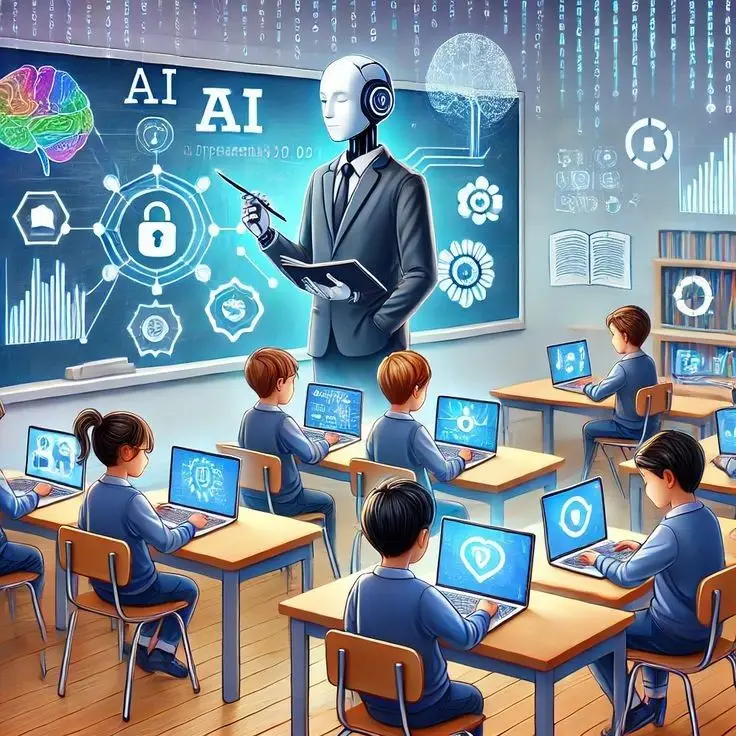
Artificial Intelligence (AI) and education are becoming increasingly connected as technology changes how people teach, learn, and access information. AI is helping students understand difficult subjects, assisting teachers with lesson preparation, improving educational research, and making learning more personalized.
In the past, education mainly depended on traditional classrooms, textbooks, libraries, and face-to-face interaction between teachers and students. Today, AI-powered tools can provide explanations, generate practice questions, translate learning materials, and offer additional academic support.
AI does not replace the importance of teachers or traditional education. Instead, it provides additional tools that can make learning more flexible, interactive, and accessible.
Understanding the relationship between artificial intelligence and education can help students, teachers, parents, and educational institutions prepare for the future.
1. AI Makes Learning More Personalized
One important connection between AI and education is personalized learning.
Every student learns differently. Some students understand lessons quickly, while others need additional explanations and practice.
AI-powered learning platforms can analyze student performance and recommend educational materials based on individual learning needs.
For example, a student struggling with mathematics may receive additional exercises and simpler explanations. Another student who performs well may receive more advanced questions.
This approach helps students learn at their own pace and allows teachers to identify areas where additional support is needed.
2. AI Helps Students Understand Difficult Subjects
Students sometimes struggle with complicated subjects such as mathematics, physics, chemistry, programming, and economics.
AI assistants can provide explanations, examples, and step-by-step guidance to help students understand unfamiliar concepts.
For example, a student studying physics can ask an AI assistant to explain Newton’s laws of motion using everyday examples.
A student learning programming can request an explanation of a particular coding concept.
This makes AI a useful academic support tool, especially when students are studying independently.
However, students should verify important information because AI-generated explanations are not always accurate.
3. AI Supports Teachers in the Classroom
Teachers play an important role in education, but preparing lessons and managing classroom activities can require considerable time.
AI can assist teachers with several responsibilities, including:
- Preparing lesson plans.
- Creating quizzes and examination questions.
- Developing classroom activities.
- Summarizing educational materials.
- Generating examples for difficult topics.
- Organizing teaching resources.
- Providing preliminary feedback on assignments.
For example, a teacher preparing a biology lesson can use AI to develop a lesson outline and create practice questions about the human digestive system.
Teachers should review the generated materials before using them to ensure they are accurate and appropriate.
4. AI Provides Virtual Tutoring
AI-powered virtual tutors are creating additional opportunities for students to receive academic assistance.
Traditional tutoring usually requires students to meet a teacher or private tutor at an agreed time.
AI tutoring tools can provide explanations and practice activities whenever students have access to the relevant technology.
Students can use virtual tutors to practice languages, understand scientific concepts, improve writing, and prepare for examinations.
This can be particularly useful for students who need additional learning support outside classroom hours.
5. AI Improves Online Education
Online education allows students to access learning materials without always attending a physical classroom.
AI makes online learning platforms more interactive by recommending courses, providing automated feedback, answering common questions, and helping students track their progress.
Some platforms also use AI to provide language translation, automatic captions, and accessibility support.
This can help students studying remotely or balancing education with employment and other responsibilities.
6. AI Helps With Educational Research
Research is an important part of education, particularly in colleges and universities.
Students and researchers often need to examine academic papers, organize information, analyze datasets, and prepare reports.
AI tools can assist with summarizing documents, identifying patterns in information, organizing research materials, and supporting certain data-analysis activities.
For example, a university student researching environmental pollution may use AI to organize research questions and identify themes in a collection of academic documents.
However, students must verify sources and ensure their research conclusions are supported by reliable evidence.
7. AI Makes Education More Accessible
AI can help students who experience difficulties accessing traditional learning materials.
Some AI-powered technologies provide:
- Text-to-speech reading assistance.
- Speech-to-text transcription.
- Automatic lecture captions.
- Translation of educational materials.
- Voice-controlled applications.
- Digital learning assistance.
For example, a student with hearing difficulties may benefit from captions during recorded lectures, while a student with visual difficulties may use software that reads digital documents aloud.
These tools can help educational institutions create more inclusive learning environments.
8. AI Supports Language Learning
Language education is another area where artificial intelligence is useful.
AI-powered language applications can help students improve pronunciation, vocabulary, grammar, listening, and writing.
Students can practice conversations, receive corrections, and ask questions about unfamiliar words.
For example, someone learning English can use an AI assistant to practice everyday conversations and understand how to construct sentences correctly.
Translation tools can also help students understand educational materials written in other languages.
9. AI Helps Teachers Assess Student Performance
Assessment helps teachers understand whether students are achieving their learning objectives.
AI-powered assessment systems can assist with marking certain objective questions, identifying common mistakes, and providing preliminary feedback.
For example, an online learning platform may identify that several students are struggling with the same mathematical topic.
Teachers can use this information to review the lesson and provide additional explanations.
However, important academic decisions should involve human educators, particularly when evaluating creativity, critical thinking, and complex assignments.
10. AI Prepares Students for Future Careers
Artificial intelligence is changing many industries, including healthcare, finance, agriculture, engineering, business, and communication.
Students need to understand how these technologies work and how they may affect future employment opportunities.
Education can help students develop skills such as:
- AI literacy.
- Digital communication.
- Data analysis.
- Critical thinking.
- Computer programming.
- Problem-solving.
- Creativity.
- Responsible technology use.
Learning about AI can help students become more adaptable and better prepared for workplaces where intelligent technologies are increasingly common.
11. Examples of AI Tools Used in Education
Several AI-powered platforms and applications can support different educational activities.
ChatGPT: Can help explain concepts, brainstorm ideas, summarize information, and support study activities.
Google Gemini: Can assist with explanations, research planning, writing support, and understanding educational topics.
Microsoft Copilot: Can support learning, writing, information organization, and productivity.
Khan Academy’s Khanmigo: Provides AI-supported tutoring and learning assistance for supported subjects and users.
Duolingo: Uses AI-powered features to support language learning and practice.
These tools have different features, availability, and limitations. Students should choose tools that support their learning objectives and follow their institution’s rules.
12. Challenges of Connecting AI With Education
Although AI offers several educational benefits, its use also creates important challenges.
Academic Dishonesty
Some students may use AI to generate assignments and submit the results without doing the required academic work.
Schools and universities need clear policies explaining acceptable AI use.
Incorrect Information
AI systems can sometimes generate misleading explanations, inaccurate statistics, or fabricated references.
Students should check important information using textbooks, academic journals, and trusted educational sources.
Privacy Concerns
Students and teachers should avoid entering confidential information into AI platforms that have not been approved for educational use.
Overdependence on Technology
Relying on AI for every academic task may reduce opportunities to develop independent thinking and problem-solving skills.
Students should use AI to support their understanding rather than allowing it to do all their work.
Unequal Access
Some students have reliable internet connections and modern devices, while others do not.
Educational institutions should work toward affordable technology access so that AI does not increase existing educational inequalities.
13. How Can AI and Education Work Together?
The strongest relationship between AI and education comes from combining technology with human teaching.
Students can use AI to practice lessons, explore ideas, and understand difficult subjects. Teachers can use AI to prepare materials, organize activities, and provide additional learning support.
Educational institutions can introduce responsible AI policies, train teachers, protect student information, and ensure that technology is accessible.
The purpose should be to improve the educational experience rather than replace human interaction.
Conclusion
Artificial intelligence relates to education because it provides technologies that support teaching, learning, research, assessment, and educational administration.
AI can make learning more personalized, help students understand difficult subjects, provide virtual tutoring, support teachers, and improve access to educational resources.
However, it must be used responsibly. Students should continue developing independent thinking, teachers should maintain professional judgment, and educational institutions should protect privacy and academic integrity.
Ultimately, AI and education work best together when technology supports human knowledge, creativity, and learning.
Frequently Asked Questions (FAQs)
1. What is the relationship between AI and education?
AI and education are connected through technologies that improve teaching, personalized learning, academic research, assessment, and access to educational resources.
2. How does AI help students in education?
AI helps students understand difficult topics, practice questions, improve writing, learn languages, and receive additional academic support.
3. How do teachers use AI in education?
Teachers can use AI to prepare lesson plans, create quizzes, organize learning materials, develop classroom activities, and assist with student feedback.
4. Can AI replace traditional education?
No. AI can support traditional education, but teachers, classroom discussions, practical experiences, and human interaction remain important parts of learning.
5. What are the best AI tools for education?
Popular options include ChatGPT, Google Gemini, Microsoft Copilot, Khan Academy’s Khanmigo, and Duolingo. The most suitable tool depends on the student’s learning needs.
6. What is the future relationship between AI and education?
AI will likely become more integrated into classrooms, online learning platforms, research activities, and educational administration. Responsible use and human supervision will remain essential.
SEO Information
- SEO Title: How Does AI Relate to Education? Understanding the Connection
- Focus Keyword: AI and education
- Slug: how-ai-relates-to-education
- Meta Description: Discover how AI relates to education through personalized learning, virtual tutoring, teacher support, academic research, and digital learning tools.
- Category: Artificial Intelligence / Education
- Tags: AI and Education, Artificial Intelligence, Educational Technology, AI Tools for Students, Personalized Learning, Online Education, Future of Education