
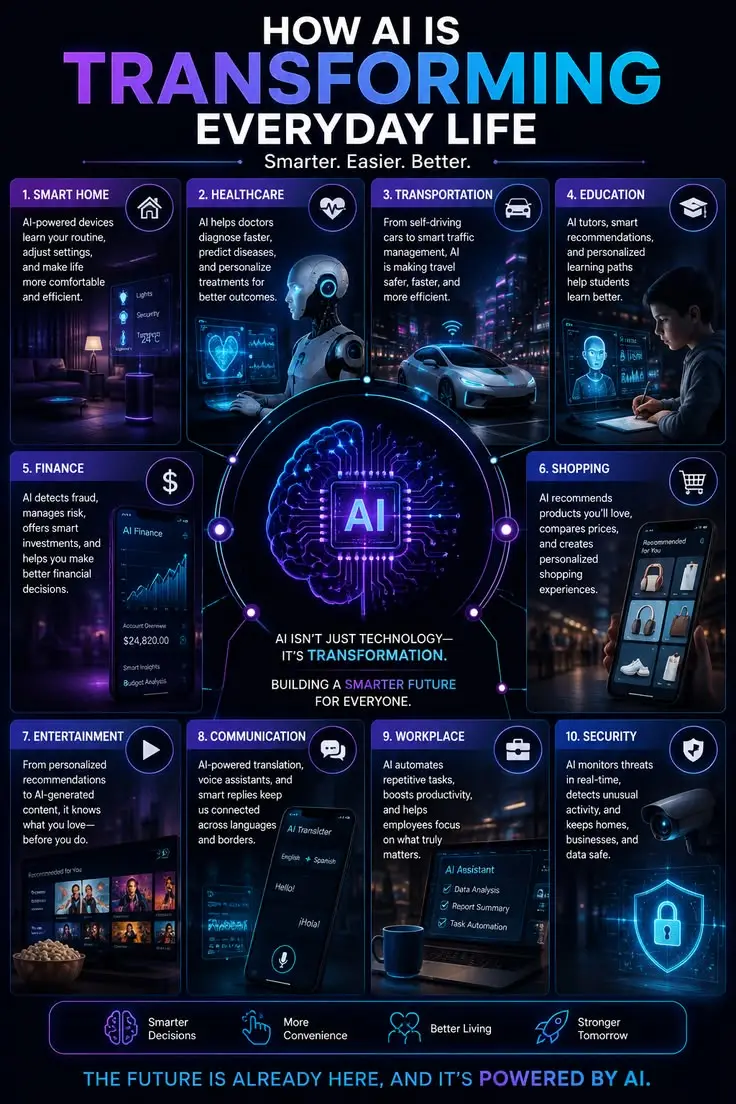
Artificial Intelligence (AI) is becoming an important tool for businesses that want to reduce operating costs, improve productivity, and increase profitability. From small businesses and startups to large corporations, companies are using AI-powered technologies to automate repetitive tasks, improve customer service, analyze financial information, and make better business decisions.
Running a business involves many expenses, including employee salaries, marketing, customer support, inventory management, administration, and daily operations. When these activities are handled inefficiently, businesses can waste time and money.
AI helps address some of these challenges by performing certain tasks faster, identifying opportunities to reduce waste, and helping employees concentrate on more valuable work.
However, AI is not automatically a money-saving solution. Businesses must choose appropriate tools, consider implementation costs, protect customer information, and monitor whether the technology actually delivers financial benefits.
This article explains how artificial intelligence helps businesses save money and why it is becoming increasingly important in modern business operations.
1. Automating Repetitive Business Tasks
One of the most effective ways AI helps businesses save money is through automation.
Many businesses spend significant amounts of time completing repetitive activities such as organizing documents, entering information, preparing reports, scheduling appointments, and responding to routine inquiries.
AI-powered automation tools can handle some of these activities with limited human intervention.
For example, an online store can use automation to organize customer orders, send order confirmations, update customers about deliveries, and generate routine reports.
This reduces manual work and allows employees to concentrate on activities that require human judgment.
Automation can also reduce certain administrative errors, which may otherwise create additional costs.
2. Reducing Customer Service Expenses
Customer service is essential for maintaining customer satisfaction, but managing a large support team can be expensive.
Businesses often receive similar questions about prices, products, delivery arrangements, opening hours, and refunds.
AI-powered chatbots can answer many routine questions automatically.
For example, an online business can install a chatbot on its website to respond to common customer inquiries at any time of the day.
The chatbot may provide product information, explain delivery procedures, and direct customers to relevant support resources.
This can reduce the workload on customer service employees and help businesses manage larger volumes of inquiries.
However, complicated complaints and sensitive customer issues should still be handled by trained human representatives.
3. Improving Marketing Efficiency
Marketing can consume a significant portion of a business’s budget.
Companies spend money on advertising, social media campaigns, email marketing, content creation, and promotional activities.
AI can help businesses use their marketing budgets more effectively by analyzing customer behavior, identifying audience interests, and assisting with campaign optimization.
For example, an online retailer can analyze customer purchase patterns to identify which products are popular with particular audiences.
AI tools can also help marketers create advertising ideas, write draft promotional messages, organize content calendars, and test different campaign approaches.
Better targeting can reduce wasted advertising expenditure and help businesses concentrate on audiences who are more likely to become customers.
AI does not guarantee lower advertising costs or higher sales, so businesses should measure campaign performance before increasing their budgets.
4. Reducing Employee Workload and Improving Productivity
Businesses do not necessarily need to reduce their workforce to benefit financially from AI.
Instead, they can use AI to help employees complete certain tasks more efficiently.
For example, employees can use AI tools to summarize long documents, organize information, prepare reports, draft emails, and analyze data.
A marketing employee who previously spent hours organizing campaign information may use AI to prepare an initial summary more quickly.
Similarly, an accountant may use approved automation tools to organize financial records and identify transactions requiring additional review.
When employees spend less time on repetitive activities, they can concentrate on customer relationships, planning, creativity, and business development.
The financial benefit comes from improving the value of existing working hours.
5. Preventing Inventory Waste
Inventory management is an important area where AI can help businesses reduce unnecessary expenses.
Retailers, manufacturers, restaurants, and wholesalers need to maintain appropriate stock levels.
Ordering too much inventory can result in storage expenses, damaged goods, expired products, and unsold stock. Ordering too little can lead to lost sales and dissatisfied customers.
AI-powered forecasting systems can analyze historical sales, seasonal demand, and other relevant information to help businesses estimate future inventory requirements.
For example, a supermarket may use sales information to identify products that sell faster during particular seasons.
This can help managers make better purchasing decisions and reduce unnecessary inventory costs.
However, forecasts should be reviewed regularly because unexpected events can change customer demand.
6. Improving Financial Management
AI can help businesses organize and analyze financial information.
Companies need to monitor revenue, expenses, cash flow, outstanding invoices, budgets, and financial performance.
AI-supported financial tools can assist with categorizing transactions, identifying unusual spending patterns, preparing financial summaries, and highlighting possible cash-flow problems.
For example, a small business may use financial software with AI features to identify categories where expenses have increased significantly.
Business owners can then investigate the reasons and decide whether adjustments are necessary.
AI can also assist with invoice processing and payment reminders, helping businesses manage routine financial administration.
Important accounting, tax, and financial decisions should still be reviewed by qualified professionals.
7. Reducing Fraud and Financial Losses
Fraud can create serious financial problems for businesses.
Companies may experience suspicious transactions, unauthorized account access, payment fraud, false invoices, or other security threats.
AI-powered fraud detection systems can analyze transaction patterns and identify activities that appear unusual.
For example, a financial institution may use AI to flag a transaction that differs significantly from a customer’s normal spending behavior.
Businesses can also use AI-supported cybersecurity systems to identify potential threats and detect suspicious login activities.
These technologies may help organizations respond more quickly to certain risks and reduce potential financial losses.
However, AI detection systems can produce false alarms and may miss some threats. Human investigation and strong security procedures remain essential.
8. Lowering Recruitment and Training Costs
Recruiting new employees can be expensive.
Businesses spend money advertising vacancies, reviewing applications, arranging interviews, and training successful candidates.
AI-powered recruitment tools can assist with organizing applications, scheduling interviews, answering common recruitment questions, and managing candidate information.
For example, a company receiving hundreds of applications may use an approved recruitment system to organize applications according to relevant qualifications and experience.
AI can also support employee training by helping organizations prepare learning materials and provide access to internal information.
However, recruitment decisions must be fair, transparent, and supervised by people. Automated systems should not be allowed to make important employment decisions without appropriate human review.
9. Improving Business Decision-Making
Poor business decisions can lead to wasted money.
For example, a company may invest in products customers do not want, expand into an unsuitable market, or spend heavily on an unsuccessful marketing campaign.
AI can help businesses analyze information before making decisions.
It can examine sales records, customer feedback, market trends, and operational data to identify patterns that may not be immediately obvious.
A clothing retailer, for instance, may analyze previous sales to identify which product categories are performing well.
Management can use these insights when deciding what to purchase, promote, or discontinue.
AI provides information to support decision-making, but business leaders must still consider market conditions, experience, and other relevant factors.
10. Reducing Energy and Operational Costs
Businesses that operate offices, factories, warehouses, and commercial buildings often spend significant amounts on electricity and equipment maintenance.
AI-powered energy management systems can analyze energy consumption and help organizations identify opportunities to reduce waste.
For example, an intelligent building management system may adjust heating, cooling, and lighting based on occupancy and operating conditions.
Manufacturing companies can also use predictive maintenance systems to analyze equipment performance and identify signs of possible failure.
Addressing maintenance issues earlier may help reduce unexpected breakdowns, repair expenses, and production interruptions.
The actual savings depend on the equipment, energy costs, system accuracy, and implementation expenses.
11. Helping Small Businesses Compete With Larger Companies
AI is not only useful for large corporations. Small businesses can also benefit from affordable AI tools.
A small business owner may use AI to prepare social media content, draft customer emails, organize product descriptions, summarize documents, and create marketing plans.
For example, a small online clothing store may use AI to prepare product descriptions and draft responses to common customer questions.
This can reduce the need to outsource every routine activity.
However, small businesses should choose tools that solve genuine problems rather than paying for several subscriptions they rarely use.
12. Examples of AI Tools Businesses Can Use
Different AI tools support different business activities.
- ChatGPT: Can assist with drafting emails, preparing business documents, brainstorming marketing ideas, and analyzing information.
- Microsoft Copilot: Can support productivity and work with compatible Microsoft applications.
- Google Gemini: Can assist with research, writing, planning, and other business tasks.
- Zapier: Helps connect applications and automate workflows, including workflows that incorporate AI.
- QuickBooks: Provides accounting and financial management features, with AI-related capabilities varying by product and plan.
- Salesforce Einstein: Offers AI-powered capabilities for customer relationship management and sales activities.
Businesses should compare pricing, security, integrations, and features before choosing a tool.
13. How Much Money Can AI Save a Business?
There is no single amount that AI saves every business. The financial benefits depend on the company’s size, industry, existing processes, software costs, and the tasks being automated.
For example, consider a business that spends 40 employee hours each month on repetitive administrative activities.
If an AI-supported workflow reduces that work by 10 hours, the business may have 10 additional employee hours available for other activities.
If the fully loaded employee cost is $20 per hour, the value of those hours is $200 per month.
This is an illustrative calculation, not a guaranteed saving. The business must also account for software subscriptions, implementation, employee training, supervision, and any errors that require correction.
A useful way to evaluate AI is to compare the total cost of using the technology with the measurable financial benefits it produces.
14. Challenges Businesses Should Consider Before Using AI
Although AI can reduce certain expenses, adopting it also creates costs and risks.
Implementation expenses: Businesses may need to pay for software, integrations, equipment, and technical support.
Training requirements: Employees need to understand how to use AI tools correctly.
Data privacy: Companies must protect customer information, employee records, and confidential business documents.
Incorrect results: AI can generate inaccurate information, so important outputs require human review.
Job disruption: Automation may change certain job responsibilities, making employee training and responsible workforce planning important.
Security risks: Businesses must evaluate the security of AI platforms and establish appropriate access controls.
Successful AI adoption requires planning, supervision, and regular performance evaluation.
15. How Businesses Can Start Saving Money With AI
Businesses do not need to automate every department immediately. A practical approach is to begin with one process that consumes considerable time or money.
Here are some useful steps:
- Identify expensive tasks: Review activities that require significant employee time or create repeated operational costs.
- Choose a suitable AI tool: Find software that addresses the specific problem.
- Start with a small project: Test the technology with a limited workflow before expanding its use.
- Train employees: Explain how to use the tool and when human review is necessary.
- Measure the results: Compare costs, time saved, accuracy, and productivity before and after implementation.
- Protect business information: Establish clear rules for handling confidential data.
- Improve gradually: Expand AI adoption only when the results justify the additional expense.
This approach helps businesses avoid unnecessary technology spending and concentrate on solutions that deliver measurable value.
Conclusion
Artificial intelligence helps businesses save money by automating repetitive tasks, improving customer service, reducing inventory waste, supporting financial management, improving marketing efficiency, and helping employees become more productive.
It can also help businesses detect potential fraud, manage energy consumption, improve maintenance planning, and make better-informed decisions.
However, AI does not guarantee financial savings. Businesses must consider implementation costs, employee training, data protection, and the accuracy of AI-generated results.
The best strategy is to identify expensive business activities, introduce suitable AI tools, and measure their financial impact.
When implemented responsibly, AI can become a valuable business investment that helps companies control expenses, improve productivity, and build more efficient operations.
Frequently Asked Questions (FAQs)
1. How does AI help businesses save money?
AI helps businesses reduce costs through automation, improved marketing, customer service chatbots, inventory forecasting, financial analysis, and better resource management.
2. Can small businesses benefit from AI?
Yes. Small businesses can use affordable AI tools for marketing, customer communication, content creation, administration, and financial organization.
3. Does AI reduce the need for employees?
AI can automate certain tasks and change job responsibilities. However, businesses still need people for decision-making, customer relationships, creativity, supervision, and complex work.
4. Can AI reduce marketing costs?
AI can help businesses analyze audiences, improve campaign targeting, prepare content, and evaluate marketing performance. Actual savings depend on how effectively the tools are used.
5. What are the best AI tools for businesses?
Popular options include ChatGPT, Microsoft Copilot, Google Gemini, Zapier, QuickBooks, and Salesforce Einstein. The best choice depends on the business’s needs and budget.
6. Is AI expensive for businesses?
Some AI tools offer free or affordable plans, while advanced business systems can require significant investment. Companies should compare the total cost with the expected benefits.
7. Will AI make businesses more profitable?
AI can support profitability by reducing unnecessary expenses and improving productivity. However, profitability also depends on customer demand, pricing, management, competition, and other business factors.
SEO Information
- SEO Title: How Does AI Help Businesses Save Money? 10+ Practical Ways
- Focus Keyword: How AI helps businesses save money
- Slug: how-ai-helps-businesses-save-money
- Meta Description: Discover how AI helps businesses save money through automation, customer service, marketing, inventory management, financial analysis, and improved productivity.
- Category: Artificial Intelligence / Business
- Tags: AI for Business, Artificial Intelligence, Business Automation, Cost Reduction, Business Productivity, AI Tools, Small Business, Business Management