Artificial intelligence has changed from something that seemed like science fiction into a technology that millions of people use every day. AI can now help people write articles, create images, analyze information, generate videos, write computer code, study, conduct research, automate repetitive tasks, and even build businesses.
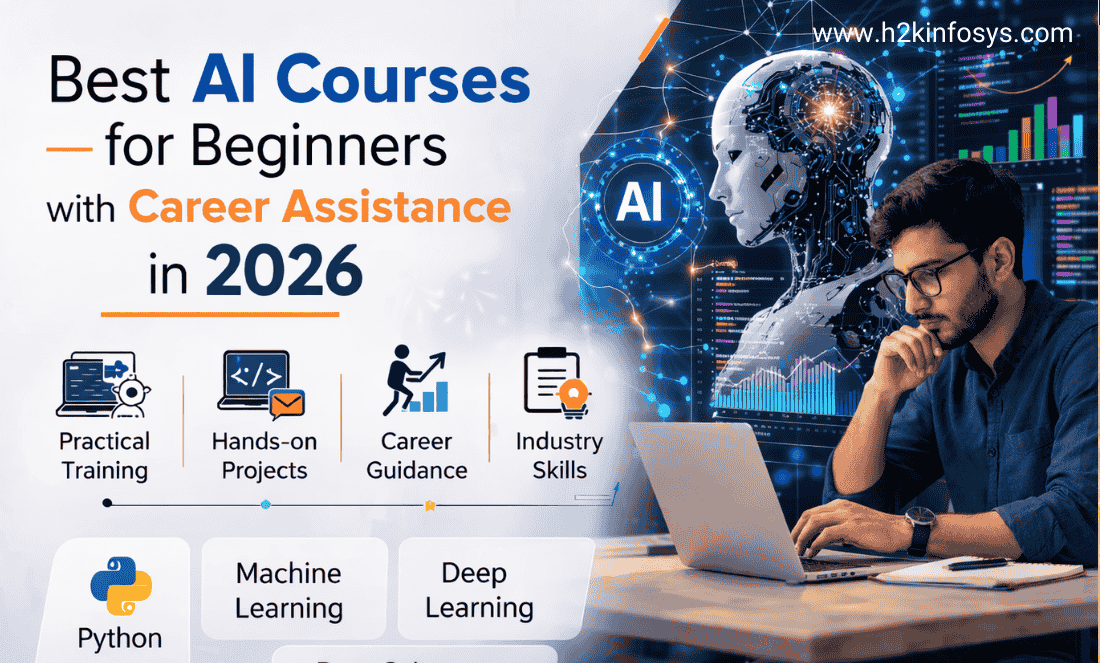
Because AI is becoming more important, many people are asking the same question: What is the best AI course for beginners?
If you are completely new to artificial intelligence, choosing a course can feel confusing. There are hundreds of AI courses online, ranging from short beginner tutorials to advanced university programs. Some focus on AI tools, while others teach machine learning, programming, data science, or AI development.
The good news is that you do not need to start with complicated mathematics or programming. There are beginner-friendly courses that can introduce you to AI step by step.
The best AI course for you ultimately depends on what you want to achieve.
Someone who wants to use AI for work may need a different course from someone who wants to become a machine-learning engineer. A freelancer may want to learn AI productivity tools, while a business owner may be more interested in AI automation.
In this guide, we will explain what beginners should look for in an AI course, popular learning options, how to choose the right course, and how you can start learning AI even if you have no technical background.
Why Should Beginners Learn AI?
Before choosing a course, it is important to understand why learning AI can be valuable.
Artificial intelligence is being used across many industries. Businesses use AI for customer service, marketing, data analysis, content creation, software development, research, and automation.
Students use AI tools to understand difficult topics, organize notes, brainstorm ideas, and practice skills.
Freelancers can use AI to improve their existing services and work more efficiently.
Content creators can use AI for brainstorming, writing, image generation, video production, and editing.
The important point is that AI does not only belong to programmers.
You can learn practical AI skills without becoming a computer scientist.
However, understanding how to use AI effectively requires more than simply opening an AI chatbot and asking random questions.
A good AI course can teach you how to:
- Understand basic AI concepts
- Use generative AI tools
- Write effective prompts
- Check AI-generated information
- Use AI responsibly
- Apply AI to real-world tasks
- Improve productivity
- Identify the limitations of AI
- Combine AI with your existing skills
These skills can remain useful even as individual AI tools change.
What Should a Beginner Look for in an AI Course?
Not every course marketed as an “AI course” is suitable for beginners.
Before paying for a course or spending weeks studying, consider several factors.
1. Beginner-Friendly Content
A good beginner course should not assume that you already understand advanced computer science.
The lessons should explain important concepts in simple language and gradually introduce more difficult ideas.
If you have never studied AI before, avoid starting with a course that immediately focuses on advanced mathematics, neural-network architecture, or complex programming.
You can learn those topics later if your career goals require them.
2. Practical Learning
One of the biggest mistakes beginners make is spending too much time watching tutorials without practicing.
A useful AI course should encourage you to actually use what you learn.
For example, after learning about prompting, you should practice writing prompts.
After learning about AI image generation, you should create images.
After learning about AI automation, you should try building a simple workflow.
The more you practice, the easier it becomes to remember the concepts.
3. Updated Lessons
AI is developing extremely quickly.
A course created several years ago may not cover many of the tools and techniques people use today.
Before choosing a course, check when it was last updated.
Look for content covering modern topics such as:
- Generative AI
- Large language models
- AI assistants
- Prompt engineering
- AI automation
- AI agents
- Multimodal AI
- Responsible AI
- AI productivity
This does not mean older AI courses are automatically bad. Fundamental concepts can remain useful for years.
However, practical AI-tool training should generally be kept current.
4. Clear Learning Goals
The best AI course for you should match your objective.
Ask yourself:
Why do I want to learn AI?
Your answer can make the decision much easier.
Maybe you want to use AI to improve your current job.
Maybe you want to start freelancing.
Maybe you want to create content.
Maybe you want to build AI applications.
Maybe you want to understand AI because it is becoming important in your industry.
Once you know your goal, you can choose a course that teaches the skills you actually need.
Best AI Courses for Beginners
There is no single course that can honestly be called the best for every beginner.
Instead, there are several types of AI courses that can be useful depending on your goals.
1. Google AI Essentials
Google AI Essentials is designed for people who want to develop practical AI skills without needing an advanced technical background.
It introduces important AI concepts and focuses on using generative AI to improve productivity and everyday work.
This makes it an interesting option for beginners who want to understand modern AI tools rather than immediately study advanced machine learning.
A course like this can be particularly useful for:
- Students
- Office workers
- Freelancers
- Business owners
- Content creators
- Professionals who are new to AI
If your main goal is to understand how AI can help you work more efficiently, a practical introductory course may be more appropriate than a highly technical machine-learning program.
2. Microsoft Learn
Microsoft Learn offers a large collection of AI learning resources for people at different experience levels.
Beginners can find material covering AI fundamentals, generative AI, prompting, AI assistants, productivity, and other related topics.
One advantage of Microsoft Learn is that you can progress from beginner material into more advanced technical subjects.
For example, someone could begin by learning how generative AI works and how to use AI assistants before eventually studying AI application development.
This makes structured learning particularly useful for people who are unsure how to progress.
3. AI for Everyone
If you want to understand artificial intelligence without becoming a programmer, an introductory course such as AI for Everyone can be worth exploring.
Courses of this type focus more on understanding what AI can do, how organizations use AI, and how to think about AI projects.
This is particularly useful for business owners, managers, students, and professionals who need AI knowledge but do not necessarily want to become AI engineers.
For example, a business owner may not need to know how to train a neural network.
Instead, they may need to know:
- What problems AI can solve
- Where AI can improve productivity
- What AI cannot do
- How to evaluate an AI project
- What risks AI creates
- How employees can use AI responsibly
That kind of knowledge can be extremely valuable.
What About Machine Learning Courses?
Some beginners see the phrase “AI course” and assume they should immediately start learning machine learning.
That is not necessarily the case.
Machine learning is an important part of artificial intelligence, but it is more technical than simply learning how to use AI applications.
Machine-learning courses can introduce subjects such as:
- Python programming
- Data preparation
- Supervised learning
- Unsupervised learning
- Algorithms
- Model training
- Model evaluation
- Statistics
If your goal is to become an AI developer, data scientist, or machine-learning engineer, these subjects will eventually become important.
However, if your goal is simply to use AI tools for writing, business, research, marketing, or productivity, you do not need to begin there.
What Is the Best AI Course for Someone With No Coding Experience?
If you have never written code before, do not let that stop you from learning AI.
There are two broad paths you can take.
The non-technical path
This focuses on using existing AI tools.
You can learn:
- Prompting
- AI writing
- AI research
- AI image generation
- AI video creation
- AI productivity
- AI marketing
- AI automation
This path can be useful for freelancers, students, creators, entrepreneurs, and employees.
The technical path
This focuses on building AI systems.
You may eventually need to learn:
- Python
- Mathematics
- Statistics
- Data science
- Machine learning
- Deep learning
- APIs
- Databases
- Model deployment
This path takes considerably longer but can lead toward technical AI careers.
Neither path is automatically better. They simply have different purposes.
Can You Learn AI for Free?
Yes.
You do not have to spend thousands of dollars to begin learning AI.
There are many free or partly free resources available online.
You can learn through:
- YouTube tutorials
- Official AI documentation
- Microsoft Learn
- Free educational articles
- Online communities
- AI tool documentation
- University materials
- Free introductory courses
- Practice projects
One of the best strategies is to combine different resources.
For example, you could use a free course to understand the fundamentals, YouTube tutorials to see practical demonstrations, and an AI tool itself to practice.
This approach can give you both theory and practical experience.
Why Learning by Doing Is So Important
Imagine watching 20 videos about riding a bicycle without ever getting on one.
You might understand the theory, but you would still struggle when you actually tried to ride.
AI works in a similar way.
Watching tutorials can help, but you need practical experience.
If you are learning prompting, create prompts.
If you are learning AI writing, write something.
If you are learning image generation, create images.
If you are learning AI automation, build a simple automation.
If you are learning AI programming, build a small application.
This is why personal projects are so important.
A Simple 30-Day AI Learning Plan for Beginners
If you are unsure where to begin, try this four-week plan.
Week 1: Understand Artificial Intelligence
Spend the first week learning the basics.
Learn what:
- Artificial intelligence is
- Machine learning is
- Generative AI is
- Large language models are
- AI assistants are
- AI tools can do
Do not worry about understanding everything.
Your goal is to build a foundation.
Week 2: Learn Prompting
Next, learn how to communicate effectively with AI.
A good prompt usually includes clear instructions and useful context.
For example, instead of saying:
“Write about marketing.”
You could say:
“Write a 1,000-word beginner-friendly article explaining five digital marketing strategies for small businesses. Use simple English, headings, practical examples, and a conclusion.”
The second prompt gives the AI a much clearer objective.
Practice changing your prompts and comparing the results.
Week 3: Explore AI Tools
Choose tools based on your interests.
If you are a writer, explore writing and research tools.
If you are a designer, explore image-generation tools.
If you create videos, explore AI video and voice tools.
If you run a business, explore productivity and automation tools.
Do not try to learn 50 tools at once.
Choose two or three and learn them properly.
Week 4: Build a Project
This is where your knowledge becomes practical.
Create something.
For example:
- Start a blog
- Create a YouTube video
- Build a presentation
- Create social media content
- Develop a simple website
- Create a marketing plan
- Build a basic AI-powered application
- Create a research project
Your first project does not need to be perfect.
The purpose is to learn how to use AI to solve an actual problem.
How Much Time Should You Spend Learning AI?
You do not need to study for eight hours every day.
Consistency is more important.
For a beginner, even 30 to 60 minutes a day can be useful.
You could divide your time like this:
15 minutes: Learn a new concept.
20 minutes: Practice using an AI tool.
15 minutes: Work on a personal project.
10 minutes: Review what you learned.
If you do this consistently for several weeks, you can build a strong foundation.
Should You Pay for an AI Course?
Not necessarily.
Before spending money, explore free resources.
You should consider paying for a course when it provides something you cannot easily get from free material.
For example, a paid course may offer:
- A structured curriculum
- Instructor support
- Projects
- Assignments
- Community access
- Feedback
- Career guidance
- A recognized certificate
However, be careful with courses that make unrealistic promises.
You should be suspicious of claims such as:
“Become an AI expert in seven days.”
“Make thousands of dollars instantly with AI.”
“Master every AI tool in one week.”
Learning AI can create opportunities, but there is no legitimate shortcut that guarantees instant success.
Common Mistakes Beginners Should Avoid
Trying to Learn Everything
AI is enormous.
There is no reason to learn every tool.
Start with a specific goal.
Following Outdated Tutorials
Always check whether the information still applies to the current version of a tool.
Trusting Every AI Answer
AI systems can make mistakes.
Always verify important information, especially when dealing with financial, legal, medical, academic, or professional decisions.
Ignoring Privacy
Do not casually upload sensitive personal information, passwords, confidential business documents, financial details, or other private information into AI tools.
Understand the privacy and data policies of the tools you use.
Depending Completely on AI
AI should support your thinking, not replace it.
Learn to review, edit, fact-check, and improve AI-generated results.
Frequently Asked Questions About AI Courses
What is the best AI course for beginners?
There is no single best course for everyone. Beginners interested in practical AI use should consider introductory courses focused on generative AI, prompting, and productivity. People interested in AI development should eventually move into programming and machine learning.
Can I learn AI without a degree?
Yes. Many practical AI skills can be learned independently through online courses, tutorials, documentation, and projects.
A degree can be useful for certain professional and research positions, but it is not required to begin learning how to use AI tools.
Can I learn AI without coding?
Yes. Many AI applications can be used without programming.
Coding becomes more important if your goal is to develop AI systems or pursue technical machine-learning careers.
How long does it take to learn AI?
Learning basic AI concepts can take several weeks. Becoming highly skilled in technical AI development can take months or years depending on your goals, previous experience, and the amount of time you dedicate to learning.
Is it too late to learn AI?
No.
AI is still developing rapidly, and new tools and applications continue to appear.
You do not need to have started years ago. You can begin by learning the fundamentals and practicing with current tools.
Final Thoughts: What Is the Best AI Course for Beginners?
The best AI course for beginners is not necessarily the most expensive, longest, or most advanced course.
It is the course that matches your current level and your reason for learning AI.
If you want to use AI for everyday productivity, content creation, business, research, or work, start with a practical beginner course focused on generative AI and AI tools.
If you want to become an AI developer, start with the fundamentals and gradually move into Python, machine learning, data science, and AI application development.
If you want to understand AI from a business perspective, focus on courses that explain AI applications, opportunities, limitations, and responsible adoption.
Most importantly, do not spend all your time searching for the “perfect” course.
Choose a reputable beginner resource, start learning, and practice what you learn.
AI is changing quickly, so the ability to learn, experiment, evaluate information, and adapt to new tools may be more valuable than memorizing one particular AI platform.
Start with one course. Learn one skill. Build one project.
Then keep going.
The people who become comfortable with AI will not necessarily be those who know every tool available. They will be the people who understand how to use AI effectively, responsibly, and creatively to solve real problems.
If you are a complete beginner, there is no need to wait until you feel ready. Your AI learning journey can start with your first lesson today.