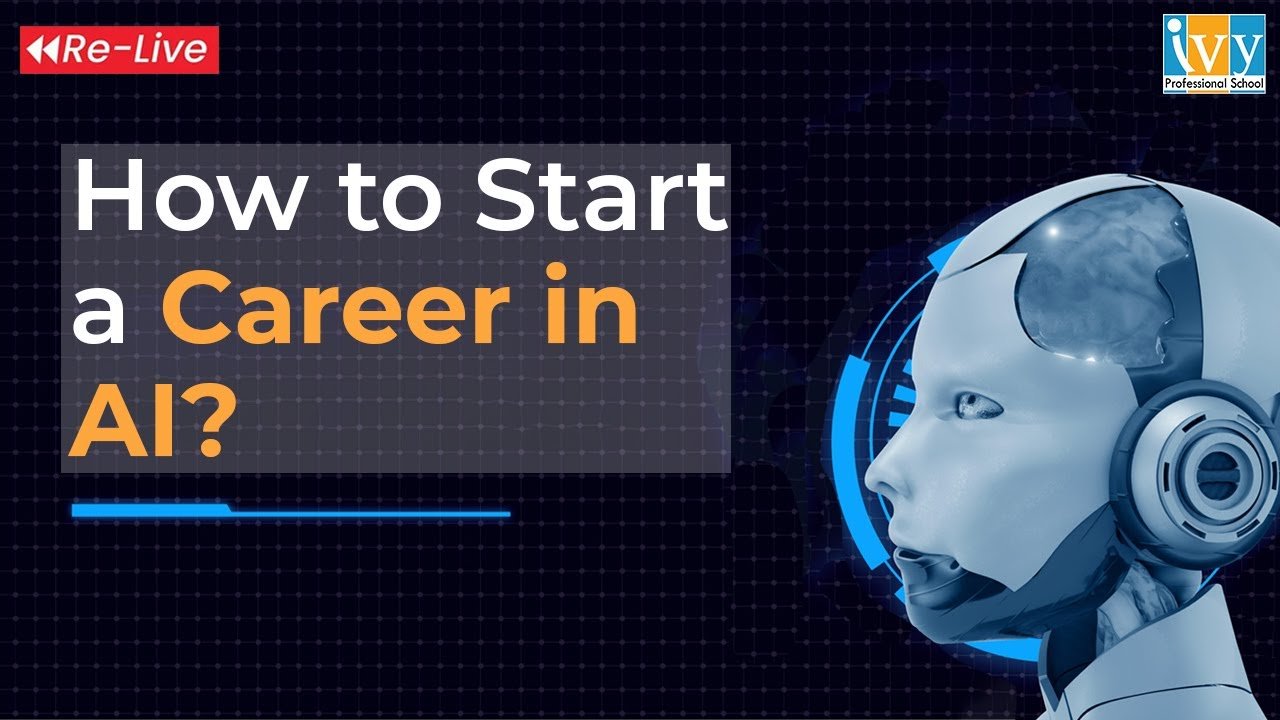
Artificial intelligence is changing the way people work, communicate, create content, solve problems, and run businesses. As AI tools become more common, many people are beginning to consider a career in artificial intelligence.
But there is one question that stops many beginners from getting started:
How do I start an AI career with no experience?
If you have never worked in technology, do not have a computer science degree, or have never written a line of code, you may feel that an AI career is out of reach.
The reality is more encouraging.
You do not have to know everything about artificial intelligence before you begin. You can start by learning the fundamentals, developing practical skills, building projects, and gradually moving toward the type of AI career that interests you.
AI is also a broad field. You do not necessarily have to become a machine learning engineer to have a career involving artificial intelligence. There are opportunities related to AI content creation, data, automation, software development, research, product management, AI operations, marketing, and many other areas.
In this guide, we will explain how to start an AI career with no experience, what skills you should learn, whether you need a degree, how to build a portfolio, and how to get your first opportunity.
What Is an AI Career?
Before starting, it is important to understand that “AI career” does not describe only one job.
Artificial intelligence is a large field with many different career paths.
Some AI-related roles are highly technical, while others require more business, communication, analytical, or creative skills.
Examples include:
- Machine learning engineer
- AI engineer
- Data scientist
- AI researcher
- AI product manager
- AI automation specialist
- AI consultant
- Data analyst
- Prompt-focused AI specialist
- AI content specialist
- AI operations specialist
- Software developer working with AI
- AI marketing specialist
The requirements for these careers can be very different.
For example, a machine learning engineer will generally need strong programming and mathematical skills, while someone using AI for marketing may need marketing knowledge combined with strong AI-tool skills.
This is good news for beginners because you can choose a path that matches your existing strengths.
Can You Start an AI Career With No Experience?
Yes.
However, there is an important distinction between starting to learn AI and qualifying for a highly technical AI job.
You can start learning AI immediately without professional experience.
You can also build projects without having worked for an AI company.
But if you want a technical position such as a machine learning engineer, you will need to develop the necessary technical skills and demonstrate that you can apply them.
Your lack of experience should therefore be treated as your starting point rather than a permanent limitation.
The goal is to gradually replace “no experience” with:
knowledge → practice → projects → portfolio → real-world experience → job opportunities.
Step 1: Learn the Basics of Artificial Intelligence
The first thing you should do is understand what AI actually is.
You do not need to begin with advanced mathematics.
Start by learning basic concepts such as:
- Artificial intelligence
- Machine learning
- Deep learning
- Generative AI
- Large language models
- Natural language processing
- Computer vision
- AI agents
- Data science
- Automation
You should understand what these technologies do and how they are used.
For example, generative AI refers to systems that can create new content such as text, images, audio, video, and code.
Machine learning is a broader area of AI involving systems that learn patterns from data.
Understanding these differences will help you decide which direction you want to pursue.
Step 2: Choose an AI Career Path
One of the biggest mistakes beginners make is trying to learn everything at once.
AI is too large for that.
Instead, choose a direction.
Ask yourself:
What type of work do I enjoy?
If you enjoy programming, you may want to explore AI engineering or machine learning.
If you enjoy mathematics and analyzing information, data science may be interesting.
If you enjoy business, AI consulting, product management, or automation could be worth exploring.
If you enjoy writing and content creation, you can learn how AI can support content workflows.
If you enjoy marketing, you can combine AI with digital marketing skills.
If you enjoy solving business problems, AI automation could be a useful direction.
Your first goal does not have to be choosing your lifelong career.
Choose a direction to explore.
You can change your path as you gain more knowledge.
Step 3: Learn How to Use AI Tools
Before diving into advanced technical concepts, become comfortable using modern AI tools.
You can experiment with tools for:
- Writing
- Research
- Image creation
- Video production
- Coding
- Data analysis
- Presentations
- Productivity
- Automation
The goal is not to memorize dozens of tools.
Instead, learn how AI can solve actual problems.
For example, take a task you normally perform manually and ask:
Can AI help me do this faster or better?
Then test the idea.
This practical approach will teach you much more than simply reading lists of AI tools.
Step 4: Learn Prompting
Prompting is the process of giving instructions to an AI system to get a useful result.
Although AI models are becoming easier to use, knowing how to communicate clearly with them remains valuable.
A weak prompt might be:
“Write a business plan.”
A stronger prompt might explain:
- The type of business
- The target audience
- The location
- The business goal
- The desired format
- The tone
- The information that should be included
The more relevant context you provide, the easier it can be for an AI system to understand your objective.
However, prompting should not be viewed as a magic skill that replaces deeper knowledge.
The best results usually come from people who understand the subject they are asking AI to work on.
Step 5: Learn the Technical Skills If You Want a Technical AI Career
If you want to become an AI engineer or machine learning professional, you will eventually need technical skills.
One of the most useful programming languages to learn for AI and data work is Python.
You should consider learning:
Python
Learn programming fundamentals such as:
- Variables
- Functions
- Loops
- Lists
- Dictionaries
- Classes
- File handling
- Libraries
Mathematics
Depending on your career path, you may need:
- Algebra
- Probability
- Statistics
- Linear algebra
- Calculus
You do not necessarily need to master all of these before writing your first AI program.
Learn them gradually as you encounter them.
Data
AI depends heavily on data.
Learn how to:
- Clean data
- Organize data
- Analyze data
- Visualize data
- Work with datasets
Machine Learning
Once you understand programming and data basics, you can begin learning machine-learning concepts.
These can include:
- Training data
- Features
- Labels
- Models
- Classification
- Regression
- Clustering
- Model evaluation
This path requires more time, but it can prepare you for more technical AI roles.
Step 6: Take Online AI Courses
You do not have to return to university before you can start learning AI.
There are many online courses designed for beginners.
You can find courses covering:
- AI fundamentals
- Generative AI
- Machine learning
- Python
- Data science
- Deep learning
- AI automation
- Prompting
- AI business applications
Some resources are free, while others require payment.
When choosing a course, look beyond the title.
Check:
- Who created it
- When it was updated
- What topics it covers
- Whether it includes projects
- Whether it matches your career goal
- Whether it assumes previous knowledge
Avoid choosing a course simply because it claims to make you an “AI expert” quickly.
Real skills require practice.
Step 7: Build AI Projects
This is one of the most important steps for someone without professional experience.
You need evidence that you can actually use what you have learned.
That evidence can come from projects.
For example, if you want to become an AI developer, you could build:
- A simple chatbot
- A document question-answering application
- An AI-powered search tool
- A text classification project
- A recommendation system
- An image classification project
If you are interested in AI automation, you could create:
- An automated email workflow
- A customer-support workflow
- A lead-processing system
- An automated content workflow
- A data-processing workflow
If you are interested in AI content, you could create:
- A blog
- A YouTube channel
- An AI-assisted content workflow
- A research newsletter
- A social media content system
Your projects do not need to be enormous.
A small completed project is usually more useful for learning than ten unfinished ideas.
Step 8: Create an AI Portfolio
Once you have completed several projects, organize them into a portfolio.
A portfolio gives employers or clients something concrete to evaluate.
Your portfolio can include:
Project name: What did you build?
Problem: What problem were you trying to solve?
Technology: What tools or programming languages did you use?
Process: How did you build it?
Result: What did the project accomplish?
Lessons: What did you learn?
If you are using GitHub for technical projects, include clear documentation so someone else can understand your work.
If you are pursuing a non-technical AI career, you can create a website or online portfolio showing your projects and case studies.
Step 9: Get Real-World Experience
You may be thinking:
“How can I get experience if every job asks for experience?”
This is a common problem for beginners.
The answer is to look for opportunities to gain practical experience before landing your ideal full-time job.
You could:
- Build projects for yourself
- Help a small business
- Volunteer your skills
- Take freelance projects
- Participate in competitions
- Join open-source projects
- Complete internships
- Work on student projects
- Help organizations automate simple tasks
For example, imagine you learn AI automation.
Instead of simply writing “AI automation” on your resume, you could help a small business automate a repetitive workflow.
Now you have an actual example of applying your skill.
That is much more valuable than simply saying you completed a course.
Step 10: Learn to Solve Problems, Not Just Use Tools
AI tools will continue to change.
A particular application that is popular today may be replaced or significantly changed in the future.
This is why you should focus on problem-solving rather than becoming dependent on one tool.
Instead of saying:
“I know how to use Tool X.”
Think:
“I know how to use AI to solve this type of problem.”
That difference can make your skills more transferable.
For example, instead of only learning one AI writing platform, learn how to:
- Research information
- Create outlines
- Generate drafts
- Fact-check information
- Edit content
- Create publishing workflows
Then you can adapt when different tools become available.
Do You Need a Degree to Start an AI Career?
It depends on the career.
Some technical AI roles may have degree requirements or strongly value formal education, particularly research-oriented positions.
However, many AI-related opportunities are more focused on practical skills and experience.
If your goal is to use AI for content, marketing, automation, business, or certain freelance services, you may be able to develop relevant skills through self-study and practical experience.
Even when a degree is not required, education can still be valuable.
The important point is that a degree and practical skills are not necessarily opposites.
You can learn independently while also pursuing formal education if that is appropriate for your situation.
How Long Does It Take to Start an AI Career?
There is no fixed timeline.
Your progress depends on your current skills, the career path you choose, and how much time you can dedicate to learning.
Someone learning AI productivity tools may become comfortable within a few weeks.
Someone learning machine learning engineering may need months or years of consistent study and project development.
A useful approach is to focus on milestones rather than a deadline.
For example:
Month 1: Learn AI fundamentals.
Month 2: Learn your chosen tools and skills.
Month 3: Build your first projects.
Month 4: Build a portfolio.
Month 5: Start applying for freelance, internship, or entry-level opportunities.
The exact timeline can vary, but having milestones gives you something concrete to work toward.
Can You Make Money With AI Without Experience?
AI can create opportunities for people with different backgrounds, but there is no guaranteed way to make money simply because you learn AI.
Your income will depend on your skills, the market, the services you offer, your ability to find clients or employers, and the value you provide.
Some beginners explore areas such as:
- AI-assisted content creation
- AI automation
- AI consulting
- AI-related freelancing
- Data analysis
- AI-powered marketing
- Website development
- AI application development
The safest approach is to combine AI with another useful skill.
For example:
AI + writing
AI + marketing
AI + programming
AI + graphic design
AI + video editing
AI + business
AI + data analysis
This gives you a practical foundation instead of relying entirely on one AI tool.
Mistakes to Avoid When Starting an AI Career
Trying to Learn Everything
You cannot master every part of AI.
Choose a direction and go deeper.
Collecting Courses Without Completing Them
Buying or bookmarking courses does not create skills.
Finish courses and practice what you learn.
Avoiding Projects
Projects demonstrate practical ability.
Start building early.
Following AI Hype
Not every AI trend will become a long-term career opportunity.
Focus on fundamental skills and real problems.
Copying AI-Generated Work Without Checking It
AI can produce inaccurate or misleading information.
Learn how to verify results.
Ignoring Communication Skills
Technical skills are important, but communication, teamwork, writing, problem-solving, and critical thinking can also be valuable in professional environments.
A Simple Beginner Roadmap to an AI Career
If you feel overwhelmed, use this roadmap.
Stage 1: Explore
Spend one or two weeks learning what AI is and how it is being used.
Stage 2: Choose
Select one career direction.
Stage 3: Learn
Take beginner courses and study the necessary skills.
Stage 4: Practice
Use AI tools and complete exercises.
Stage 5: Build
Create three to five practical projects.
Stage 6: Document
Create a portfolio showing what you built.
Stage 7: Gain Experience
Look for freelance work, internships, volunteer projects, open-source opportunities, or entry-level roles.
Stage 8: Keep Learning
AI will continue changing, so continue improving your skills.
Frequently Asked Questions
Can I start an AI career with absolutely no experience?
Yes, you can begin learning AI with no previous professional experience. However, technical AI jobs require you to develop the skills needed for those positions. Start with fundamentals and build experience through projects.
Do I need to be good at mathematics?
It depends on your career path. Advanced mathematics is more important for technical machine-learning and research roles. You can start learning practical AI tools without advanced mathematics.
Do I need to learn Python?
If you want to pursue AI engineering, machine learning, data science, or AI development, Python is highly useful. If you mainly want to use AI tools for business, writing, marketing, or productivity, programming may not be necessary at first.
Can I learn AI online?
Yes. Online courses, tutorials, documentation, communities, and practical projects provide many ways to learn AI.
What should I put in an AI portfolio?
Include projects that demonstrate your skills. Explain the problem, tools, process, and results for each project.
Is AI a good career for beginners?
AI is a broad field, so the answer depends on the specific career you choose. Beginners can start by developing practical AI skills and then progress toward more specialized roles.
Final Thoughts
Starting an AI career with no experience can seem intimidating, but you do not need to know everything before taking the first step.
Start by learning the fundamentals of artificial intelligence. Then choose a specific direction based on your interests and existing skills.
If you enjoy programming, explore Python, data, and machine learning.
If you enjoy business, explore AI automation and business applications.
If you enjoy marketing, learn how AI can improve research, content, advertising, and customer communication.
If you enjoy creating content, explore AI writing, image, audio, and video tools.
The most important thing is to move beyond watching tutorials.
Learn, practice, build, and show your work.
Your first project may be small. Your first portfolio may not be perfect. Your first application may not result in a job.
That is normal.
The goal is to turn your lack of experience into a learning journey that eventually produces real evidence of your abilities.
AI is developing rapidly, and new tools and applications will continue to appear. Rather than trying to predict exactly which tool will dominate the future, focus on skills that remain useful: problem-solving, programming when required, data understanding, communication, critical thinking, responsible AI use, and the ability to learn new technologies.
You do not need to wait until you have an AI degree, years of experience, or an impressive job title.
Start where you are, choose one direction, learn consistently, build real projects, and use those projects to create your first opportunity.
That is one of the most practical ways to begin an AI career from zero.