
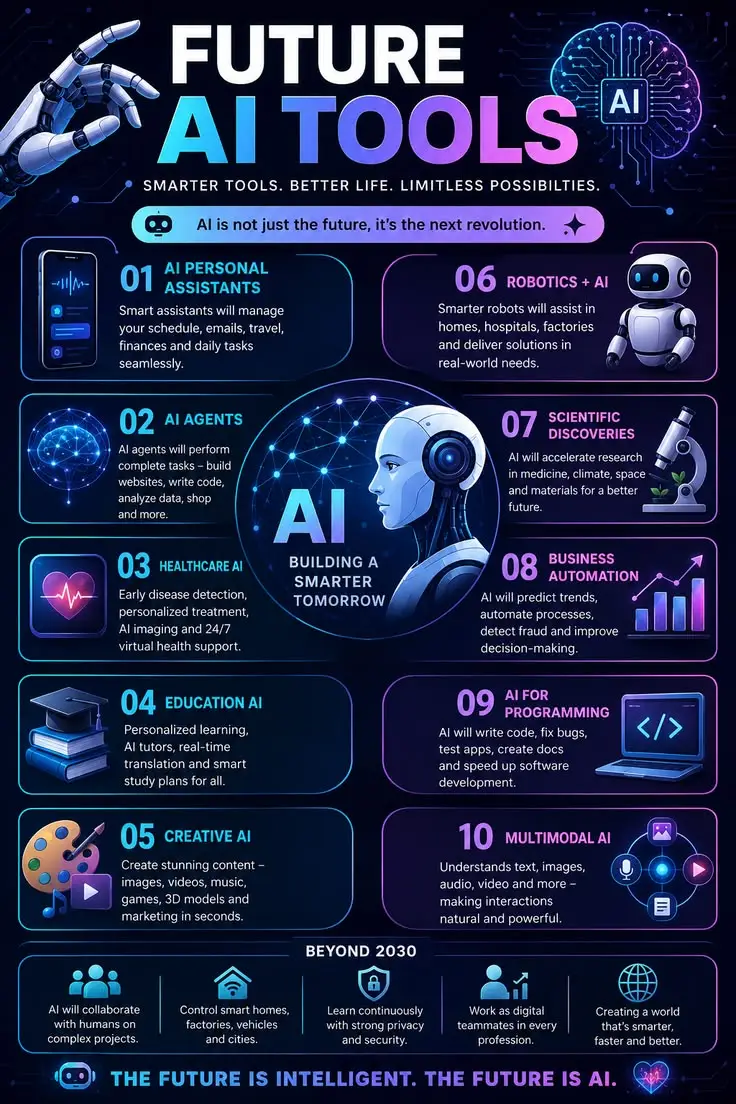
Introduction
Artificial Intelligence (AI) has become an important part of everyday life. Many people use AI without even realizing it. From smartphones and social media to online shopping and banking, AI helps make daily activities faster, easier, and more convenient.
AI refers to computer technology that can perform tasks that normally require human intelligence, such as recognizing speech, understanding language, analyzing information, and making recommendations.
Today, businesses and individuals use AI to save time, improve productivity, and solve everyday problems.
In this article, we will explore five important uses of artificial intelligence in daily life, including practical examples and the benefits of each application.
1. AI in Smartphones and Voice Assistants
One of the most common uses of artificial intelligence is in smartphones. Modern smartphones use AI-powered features to make devices smarter and easier to operate.
For example, voice assistants such as Apple’s Siri and Google Assistant can understand spoken commands and help users perform different tasks.
You can use these assistants to:
- Set alarms and reminders.
- Make phone calls.
- Search for information.
- Send messages.
- Check the weather.
- Open applications using voice commands.
AI also improves smartphone cameras by recognizing faces, adjusting lighting, and enhancing photographs.
Other examples include predictive text, facial recognition, voice-to-text conversion, and photo organization.
Benefits: AI makes smartphones more convenient, saves time, and helps people complete everyday activities more efficiently.
2. AI in Social Media and Entertainment
Social media platforms use artificial intelligence to recommend content based on users’ interests and online activities.
For example, when you watch videos, like photographs, or follow particular accounts, recommendation systems may analyze your activity to suggest similar content.
Platforms such as Facebook, Instagram, TikTok, and YouTube use AI-powered systems to personalize users’ experiences.
AI is also used to:
- Recommend videos and music.
- Detect spam and suspicious accounts.
- Filter certain harmful content.
- Personalize advertisements.
- Organize news feeds.
- Improve image and video editing.
Streaming services also use recommendation systems to suggest movies, television shows, and songs based on viewing and listening habits.
Benefits: AI helps users discover relevant content and makes digital entertainment more personalized.
3. AI in Education and Learning
Artificial intelligence is transforming the way students learn and teachers prepare educational materials.
Students can use AI applications to understand difficult subjects, practice questions, improve writing, and organize their study schedules.
For example, an AI learning assistant can explain a mathematics problem step by step or summarize a complicated topic in simpler language.
AI can help with:
- Explaining difficult lessons.
- Translating languages.
- Checking grammar and spelling.
- Creating practice questions.
- Preparing revision notes.
- Supporting personalized learning.
Teachers can also use AI to prepare lesson plans, create quizzes, and organize educational resources.
Benefits: AI makes learning more flexible, provides additional educational support, and helps students access information quickly.
4. AI in Banking and Online Shopping
Artificial intelligence is widely used in banking, financial services, and online shopping.
Banks use AI to identify suspicious transactions, improve customer support, and analyze financial information.
For example, if a transaction appears unusual compared with a customer’s normal spending activity, an AI-powered security system may flag it for further investigation.
In online shopping, AI recommends products based on customers’ searches, browsing activities, and previous purchases.
Other uses include:
- Detecting potentially fraudulent transactions.
- Answering customer questions through chatbots.
- Recommending products.
- Organizing household spending.
- Analyzing shopping trends.
- Supporting automated financial services.
Benefits: AI can make financial services more efficient, improve shopping experiences, and help businesses understand customer needs.
5. AI in Healthcare and Transportation
Artificial intelligence is helping improve healthcare services and transportation systems.
In healthcare, AI can assist qualified medical professionals with reviewing medical images, organizing patient information, and identifying patterns in health data.
Some healthcare applications also provide general health information and help users organize questions before medical appointments.
In transportation, AI helps navigation applications analyze traffic conditions, estimate journey times, and recommend alternative routes.
Examples include:
- Assisting with medical image analysis.
- Organizing healthcare records.
- Monitoring certain health measurements.
- Predicting traffic conditions.
- Recommending driving routes.
- Supporting vehicle safety systems.
Benefits: AI can support healthcare professionals, improve access to information, and make transportation more efficient.
Additional Benefits of AI in Daily Life
Apart from these five major uses, artificial intelligence provides several other advantages:
- Saves time: AI can automate repetitive activities.
- Improves productivity: It helps people complete certain tasks faster.
- Provides convenience: Voice assistants and smart devices simplify everyday activities.
- Improves accessibility: Translation and speech recognition tools help people communicate.
- Supports decision-making: AI can analyze information and identify useful patterns.
Disadvantages of Using AI in Everyday Life
Although AI offers many benefits, it also has some disadvantages.
- Privacy risks: Some applications collect personal information.
- Incorrect information: AI can generate inaccurate answers.
- Job displacement: Automation may affect certain occupations.
- Online scams: Criminals can use AI to create convincing fraudulent messages.
- Overdependence: Relying too heavily on AI may reduce independent problem-solving.
People should use AI responsibly and verify important information before making decisions.
Conclusion
Artificial intelligence is becoming an essential part of modern life. Its five major uses include smartphones and voice assistants, social media and entertainment, education, banking and online shopping, and healthcare and transportation.
These applications help people save time, access information, improve productivity, and complete everyday activities more conveniently.
However, AI also introduces challenges involving privacy, cybersecurity, misinformation, and employment. Understanding both its advantages and disadvantages is important for using the technology responsibly.
As artificial intelligence continues to develop, it will likely become even more integrated into how people live, work, communicate, and learn.
Frequently Asked Questions (FAQs)
1. What are the five main uses of AI in daily life?
The five main uses are smartphones and voice assistants, social media and entertainment, education, banking and online shopping, and healthcare and transportation.
2. How is AI used in smartphones?
AI helps smartphones recognize faces, improve photographs, understand voice commands, predict text, and organize images.
3. How does AI help students?
AI helps students understand difficult subjects, translate languages, improve writing, prepare revision notes, and practice questions.
4. How is AI used in banking?
Banks use AI to identify suspicious transactions, support customer service, analyze financial information, and improve security systems.
5. Is AI useful in everyday life?
Yes. AI can save time, improve productivity, provide personalized recommendations, and make many everyday activities more convenient.
6. What are the risks of using AI?
Some risks include privacy violations, misinformation, cybersecurity threats, online scams, and changes in employment opportunities.
Disclaimer: This article is for educational and informational purposes only. AI capabilities and applications may change as technology develops.