
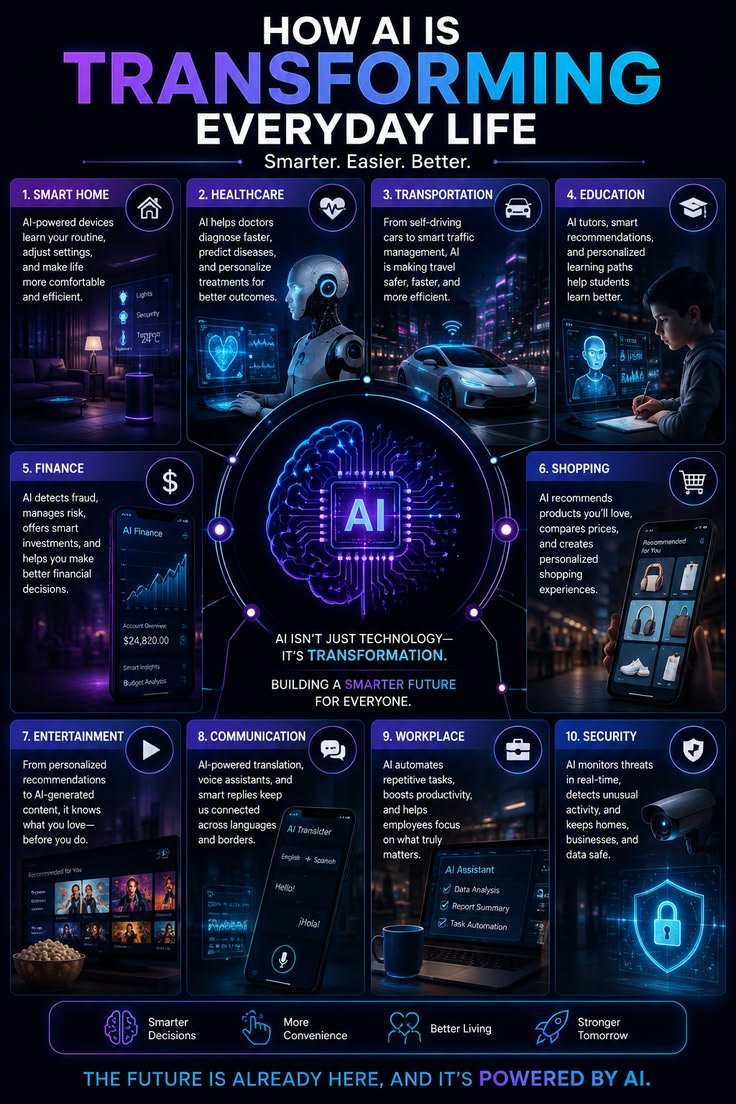
Introduction
Artificial Intelligence (AI) has become an important part of modern life. Although many people associate AI with robots, advanced computers, or science fiction, it is already used in everyday activities such as searching the internet, sending messages, shopping online, watching videos, and using smartphones.
AI refers to computer systems designed to perform tasks that normally require human intelligence. These tasks include learning from information, recognizing images, understanding language, identifying patterns, and making predictions.
Today, AI technology is helping people save time, improve productivity, communicate more easily, and make better-informed decisions. Businesses also use AI to understand customers, improve services, and automate repetitive tasks.
In this article, we will explore how artificial intelligence is used in everyday life, its benefits, common examples, potential disadvantages, and what the future may look like.
1. AI in Smartphones
Smartphones are among the most common places where people experience artificial intelligence. Many modern phone features use AI to make devices smarter and easier to operate.
For example, AI helps improve smartphone cameras by recognizing faces, adjusting lighting, identifying scenes, and enhancing image quality. Some phones can automatically optimize pictures taken in low light or portrait mode.
Voice assistants also use AI to understand spoken commands. Users can ask their phones to set alarms, make calls, search for information, or create reminders.
Other smartphone features powered by AI include:
- Facial recognition and biometric security.
- Predictive text and autocorrect.
- Voice-to-text transcription.
- Photo organization and image recognition.
- Battery and performance optimization.
These features help people complete everyday tasks more conveniently.
2. AI in Social Media
Social media platforms use artificial intelligence to personalize the content users see.
When someone watches videos, likes posts, follows accounts, or searches for particular topics, AI-powered recommendation systems can analyze these activities to suggest similar content.
For example, platforms such as Facebook, Instagram, TikTok, and YouTube use recommendation systems to help users discover videos, pages, creators, and advertisements.
AI also helps social media companies:
- Detect spam and suspicious accounts.
- Identify potentially harmful content.
- Recommend relevant posts and videos.
- Personalize advertisements.
- Improve content moderation.
However, recommendation algorithms can sometimes create repetitive content experiences by showing users material similar to what they have already viewed.
3. AI in Education
Artificial intelligence is changing how students learn and how teachers prepare educational materials.
AI-powered learning applications can explain difficult subjects, generate practice questions, summarize information, and provide feedback on assignments.
Students can use AI tools to:
- Understand complicated topics.
- Practice mathematics and science.
- Improve grammar and writing.
- Learn foreign languages.
- Create revision notes.
- Prepare for examinations.
Teachers can also use AI to prepare lesson plans, develop quizzes, organize educational resources, and identify areas where students may need additional support.
However, students should not depend entirely on AI to complete their schoolwork. They should use it as a learning assistant, verify important information, and develop their own understanding.
4. AI in Healthcare
Artificial intelligence is increasingly being used in healthcare to support medical professionals and improve healthcare services.
Some AI systems can analyze medical images, helping qualified professionals identify patterns that may indicate health problems. AI can also assist with reviewing patient information, organizing medical records, and identifying patients who may need additional attention.
Examples of AI applications in healthcare include:
Medical imaging: AI tools can assist trained professionals in examining X-rays, CT scans, and other medical images.
Virtual health assistants: Some applications provide general health information and help users organize questions before medical appointments.
Patient monitoring: AI can analyze information from supported health devices and help identify unusual patterns that may require attention.
Administrative support: Healthcare organizations can use AI to organize appointments, process documents, and manage routine administrative tasks.
AI does not replace qualified doctors or guarantee accurate diagnoses. Medical decisions should always involve appropriate healthcare professionals.
5. AI in Online Shopping
Online shopping platforms use AI to make product discovery and customer experiences more personalized.
When customers search for products, view items, or make purchases, recommendation systems may analyze their activity to suggest other products they might find useful.
AI can also help online businesses:
- Recommend products based on shopping activity.
- Answer common customer questions.
- Detect suspicious transactions.
- Predict product demand.
- Improve inventory management.
- Personalize advertisements.
For example, an online store may recommend shoes, clothing, or electronic devices based on products a customer has previously viewed.
These features can make shopping easier, although customers should compare prices and product quality rather than relying entirely on recommendations.
6. AI in Banking and Finance
Artificial intelligence is becoming increasingly important in banking and financial services.
Banks use AI-powered systems to analyze transactions, identify suspicious activity, and support customer service operations.
For example, when a transaction appears unusual, a bank’s security system may flag it for additional verification.
AI is also used for:
- Fraud detection and prevention.
- Automated customer support.
- Spending analysis.
- Credit risk assessment.
- Financial planning applications.
- Personalized banking services.
Some budgeting applications can automatically categorize spending and help users understand where their money goes.
AI can make financial services more efficient, but customers should still protect their account details and carefully review financial decisions.
7. AI in Transportation
Artificial intelligence plays an important role in modern transportation.
Navigation applications use AI-related technologies and data analysis to estimate travel times, recommend routes, and identify traffic patterns.
For example, mapping applications can suggest alternative routes when roads become congested.
AI is also used in:
- Driver-assistance systems.
- Traffic monitoring.
- Public transportation planning.
- Delivery route optimization.
- Vehicle safety systems.
- Research and development of autonomous vehicles.
Some modern vehicles use cameras and sensors to help drivers detect nearby objects, maintain safe distances, and receive warnings about potential hazards.
Although these technologies can improve safety, drivers must remain attentive and follow road regulations.
8. AI in Entertainment
Artificial intelligence influences how people watch movies, listen to music, and enjoy digital entertainment.
Streaming platforms use recommendation algorithms to suggest movies, television programs, and songs based on viewing or listening habits.
AI is also used in video games to create more responsive characters, adjust gameplay difficulty, and improve player experiences.
Other examples include:
- Automatic video editing.
- Image enhancement.
- Personalized music recommendations.
- Speech recognition and subtitles.
- Content search and discovery.
- Special effects in movies.
AI can make entertainment more personalized and interactive, but it also raises questions about copyright, creative ownership, and the use of people’s voices or images.
9. AI in Communication
Communication has become easier through AI-powered translation, speech recognition, and writing assistance.
Many messaging and communication applications use AI to provide features such as:
- Automatic translation.
- Predictive text.
- Grammar suggestions.
- Voice transcription.
- Email filtering.
- Smart replies.
For example, a person who speaks one language can use an AI translation application to understand a message written in another language.
Businesses also use AI chatbots to respond to common customer questions and provide basic support.
These tools can reduce communication barriers, although translations and automatically generated messages may sometimes contain mistakes.
10. AI in Homes and Daily Household Activities
Artificial intelligence is also becoming part of modern homes through smart devices and home automation systems.
Smart speakers can respond to voice commands, play music, provide weather information, and control compatible household devices.
Other examples include:
- Smart thermostats that adjust temperatures.
- Robot vacuum cleaners that navigate rooms.
- Smart security cameras that detect movement.
- Automated lighting systems.
- Smart appliances that monitor usage.
- Voice-controlled home assistants.
These technologies can make household activities more convenient and help people manage their homes more efficiently.
However, smart devices should be configured carefully because they may collect personal information about household activities.
11. AI in Business and Employment
Businesses use artificial intelligence to improve productivity, reduce repetitive work, and make decisions based on available data.
For example, a small business owner can use AI tools to generate marketing ideas, prepare product descriptions, organize customer inquiries, and analyze sales information.
AI applications in business include:
Customer service: Chatbots can answer frequently asked questions and direct customers to the appropriate department.
Marketing: AI can help businesses analyze customer interests and develop advertising campaigns.
Accounting: Financial software can automate some bookkeeping and expense categorization tasks.
Human resources: AI tools can assist with organizing applications and managing routine recruitment activities, although hiring decisions require careful oversight.
Content creation: AI writing and design tools can help create drafts, presentations, and marketing materials.
AI can improve productivity, but businesses should review generated information for accuracy and originality.
12. Benefits of Artificial Intelligence in Everyday Life
Artificial intelligence provides several advantages that make daily activities easier.
Saves Time
AI can automate repetitive tasks, allowing people to spend more time on important activities.
Improves Productivity
Students, workers, and business owners can use AI tools to organize information, prepare documents, and complete certain tasks more efficiently.
Provides Personalized Experiences
AI can recommend products, music, videos, and services based on individual preferences.
Improves Accessibility
Speech recognition, text-to-speech, and translation tools can help people communicate and access information more easily.
Supports Better Analysis
AI can analyze large amounts of information and identify patterns that may be difficult to notice manually.
Improves Convenience
Voice assistants, smart devices, and automated services can simplify many everyday activities.
13. Disadvantages and Risks of AI
Despite its advantages, artificial intelligence also has disadvantages that people should understand.
Privacy concerns: Some AI applications collect personal information, including location, preferences, and online activity.
Job displacement: Automation may reduce the need for certain repetitive tasks and change the skills required in some occupations.
Incorrect information: AI systems can generate inaccurate answers, misleading recommendations, or fabricated information.
Cybersecurity threats: Criminals may use AI to create convincing scam messages, impersonations, and fraudulent content.
Overdependence: Relying too heavily on AI may reduce opportunities to develop independent thinking and problem-solving skills.
Bias and unfair decisions: AI systems can produce unfair results when trained on incomplete or biased information.
People should use AI responsibly, protect their personal information, and verify important information before acting on it.
14. How to Use AI Safely in Everyday Life
You do not need to be a technology expert to benefit from artificial intelligence. However, it is important to use AI tools carefully.
Here are some practical tips:
- Use reputable AI applications and official websites.
- Avoid sharing passwords, bank details, or confidential personal information.
- Verify important information from reliable sources.
- Do not rely on AI alone for medical, legal, or financial decisions.
- Review AI-generated documents before publishing or sending them.
- Check privacy settings on applications and smart devices.
- Be cautious of suspicious messages, fake images, and AI-generated scams.
- Use AI to support your skills rather than replace your own judgment.
15. The Future of AI in Everyday Life
Artificial intelligence is expected to become even more integrated into everyday activities.
Future AI assistants may help people organize schedules, manage household expenses, communicate across languages, and complete more complicated digital tasks.
Healthcare systems may use increasingly advanced AI tools to support medical research and assist professionals. Educational applications may provide more personalized learning experiences. Businesses may automate additional administrative processes and improve customer services.
Smart homes and connected devices may also become more sophisticated, allowing people to manage lighting, security, energy use, and appliances through integrated systems.
However, the future of AI will depend on responsible development, effective regulation, cybersecurity, privacy protection, and public trust.
The goal should not simply be to create more advanced technology. It should be to develop AI systems that solve real problems and improve people’s lives.
Conclusion
Artificial intelligence is already part of everyday life, even when people do not realize they are using it. From smartphones and social media to healthcare, education, banking, transportation, and online shopping, AI is changing how people interact with technology.
Its ability to automate tasks, analyze information, and provide personalized services makes it a valuable tool for individuals and businesses.
However, AI also introduces challenges involving privacy, cybersecurity, inaccurate information, and employment changes. Understanding these risks is just as important as learning about its benefits.
As AI continues to develop, people who understand how to use it responsibly will be better prepared to take advantage