Artificial Intelligence and Machine Learning are two terms that are becoming increasingly common in today’s digital world. You may hear people use them when talking about chatbots, self-driving cars, recommendation systems, smart assistants, business automation, and many other technologies.
Because the terms are often used together, many people assume that Artificial Intelligence and Machine Learning mean exactly the same thing. They do not.
So, what is the difference between AI and Machine Learning?
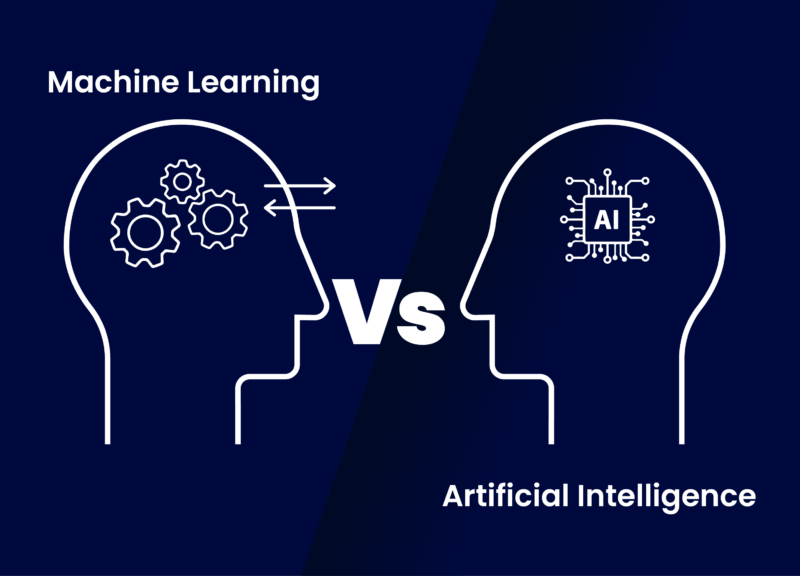
The simple answer is that Artificial Intelligence, or AI, is the broader concept of creating machines that can perform tasks associated with human intelligence, while Machine Learning, or ML, is one approach used to build AI systems by allowing computers to learn patterns from data.
In other words, Machine Learning is a part of Artificial Intelligence.
Understanding this difference can make it easier to understand how modern technologies work and why AI has become so important in areas such as education, healthcare, business, finance, entertainment, and communication.
In this article, we will explain AI and Machine Learning in simple terms, compare them, provide practical examples, discuss their benefits and limitations, and answer common questions.
What Is Artificial Intelligence?
Artificial Intelligence is a broad field of computer science focused on creating systems that can perform tasks that normally require some form of human intelligence.
These tasks can include:
- Understanding language
- Recognizing images
- Solving problems
- Making predictions
- Planning
- Recognizing patterns
- Understanding speech
- Generating content
- Making recommendations
- Assisting with decisions
AI does not mean that a computer has become a human being. Instead, it refers to technologies designed to perform particular tasks that involve capabilities commonly associated with intelligence.
For example, when you ask a digital assistant a question and it responds, an AI system is involved.
When a streaming platform recommends movies based on your interests, AI may be involved.
When an email service identifies suspicious messages, AI techniques may be used.
When a chatbot generates an answer to your question, AI technology is being used.
What Is Machine Learning?
Machine Learning is a branch of Artificial Intelligence.
Instead of programming a computer with instructions for every possible situation, Machine Learning allows a computer system to learn patterns from data and use those patterns to make predictions or produce outputs.
For example, imagine you want a computer to identify pictures of cats.
With a traditional rule-based approach, you might try to create many rules describing what a cat looks like. This would be extremely difficult because cats can have different sizes, colors, positions, and appearances.
With Machine Learning, developers can provide the system with many examples of cat and non-cat images. The system can learn patterns from those examples and use what it has learned to make predictions about new images.
This is one reason Machine Learning has become so important.
AI Is the Bigger Concept
One of the easiest ways to understand the relationship is to think of AI as a large category.
Inside the AI field are different approaches and techniques.
Machine Learning is one of those approaches.
You can think of it this way:
Artificial Intelligence → Machine Learning → Deep Learning
This is a simplified way of showing the relationship.
Machine Learning is part of AI, while Deep Learning is a specialized area within Machine Learning that uses neural networks with multiple layers.
However, not every AI system necessarily has to use Machine Learning.
Some AI systems can operate using explicitly programmed rules, logic, search techniques, planning methods, or combinations of different approaches.
The Main Difference Between AI and Machine Learning
The biggest difference is their scope.
Artificial Intelligence is the broader goal and field of creating systems that can perform intelligent tasks.
Machine Learning is a method for achieving some of those AI capabilities by allowing systems to learn patterns from data.
For example, an AI application might be designed to recognize fraudulent transactions.
Machine Learning could be used to train a model using historical transaction data so it can identify patterns associated with potentially fraudulent activity.
AI describes the larger intelligent system or objective, while Machine Learning describes one of the technologies that can help make that system possible.
AI Does Not Always Need Machine Learning
This is an important point.
People sometimes think that every AI system must learn from data. That is not necessarily true.
Some AI systems can be created using rules.
For example, imagine a simple customer-service chatbot that responds according to predefined instructions:
If a customer asks about business hours, show the business hours.
If a customer asks about shipping, show shipping information.
If a customer asks about returns, show the return policy.
This system may appear intelligent to a user, but it could be based largely on programmed rules rather than Machine Learning.
More advanced AI systems can combine rules, Machine Learning, language models, databases, and other technologies.
How Does Machine Learning Learn?
Machine Learning systems learn patterns from data.
The general process can include several steps.
1. Collecting Data
First, developers need data related to the task.
For example, if they want to build a system that predicts house prices, they might collect information about:
- House size
- Location
- Number of rooms
- Age of the property
- Previous sale prices
- Other relevant features
2. Preparing the Data
Data often needs to be cleaned and organized.
Incorrect, incomplete, duplicated, or irrelevant information can affect the quality of a Machine Learning system.
3. Training the Model
The data is used to train a Machine Learning model.
During training, the model identifies patterns that may help it make predictions or classifications.
4. Testing the Model
After training, the model can be tested using data it did not previously see.
This helps developers determine how well it performs on new examples.
5. Using the Model
Once the model is ready, it can be used to make predictions or produce outputs from new data.
Types of Machine Learning
Machine Learning can be divided into several major approaches.
Supervised Learning
In supervised learning, a model learns from examples where the desired answer is known.
For example, a system may be trained using emails labeled as “spam” or “not spam.”
The model learns patterns associated with each category.
It can then examine a new email and predict whether it is likely to be spam.
Unsupervised Learning
In unsupervised learning, the system works with data without predefined labels and tries to discover patterns or groups.
For example, a business might use an unsupervised learning method to identify groups of customers with similar purchasing behavior.
Reinforcement Learning
In reinforcement learning, a system learns through interactions with an environment and feedback about its actions.
The system attempts to improve its behavior over time based on rewards or penalties.
Reinforcement learning has been used in areas such as games, robotics, and decision-making research.
What Is Deep Learning?
Deep Learning is another important term related to AI and Machine Learning.
Deep Learning is a specialized form of Machine Learning that uses neural networks with many layers.
These systems can learn complex patterns from large amounts of data.
Deep Learning has contributed to significant advances in areas such as:
- Image recognition
- Speech recognition
- Natural language processing
- Computer vision
- Generative AI
- Autonomous systems
Modern AI applications can use deep learning models to process text, images, audio, video, and other types of information.
Examples of Artificial Intelligence
AI is used in many different technologies.
Virtual Assistants
Voice assistants can understand spoken requests and respond to users.
Recommendation Systems
Streaming services and online stores can recommend content or products based on user behavior and other information.
Customer Service
Businesses can use AI chatbots to answer common questions and assist customers.
Medical Technology
AI systems can assist professionals with analyzing medical information and identifying patterns in certain types of data.
Fraud Detection
Financial organizations can use AI and Machine Learning to identify unusual transaction patterns.
Navigation
Modern navigation systems can use algorithms and data to suggest routes and estimate travel times.
Examples of Machine Learning
Machine Learning is used behind many everyday technologies.
For example:
- Email spam detection
- Product recommendations
- Fraud detection
- Predictive maintenance
- Customer segmentation
- Speech recognition
- Image classification
- Search ranking
- Personalized advertising
- Demand forecasting
These systems can use patterns in data to make predictions or decisions.
AI vs Machine Learning: A Simple Example
Imagine you have a smartphone camera application that can recognize objects.
The overall application could be considered an AI system because it performs a task associated with intelligent perception.
Inside the application, a Machine Learning model could be responsible for recognizing objects.
For example, the model might have been trained using thousands or millions of images.
It learns patterns associated with objects such as:
- Cars
- Dogs
- People
- Trees
- Buildings
When you point the camera at something, the model analyzes the image and predicts what it contains.
In this example, AI describes the broader intelligent capability, while Machine Learning is one of the methods used to provide that capability.
AI vs Machine Learning: Key Differences
The following comparison makes the difference easier to understand.
| Feature | Artificial Intelligence | Machine Learning |
|---|---|---|
| Meaning | Broad field of intelligent computer systems | A branch of AI that learns patterns from data |
| Scope | Very broad | More specific |
| Main goal | Perform tasks associated with intelligence | Learn from data to make predictions or decisions |
| Requires data? | Not always | Usually relies heavily on data |
| Includes rules? | Yes | Can be combined with rules |
| Relationship | Larger field | Part of AI |
| Examples | Planning systems, AI assistants, expert systems | Spam detection, recommendation models, prediction systems |
Why Is Machine Learning Important for Modern AI?
Machine Learning has become extremely important because many real-world problems are too complex to solve with simple rules.
Consider image recognition.
There are countless ways an object can appear in an image. It could be close, far away, partly hidden, rotated, brightly lit, or poorly lit.
Writing a rule for every possible situation would be extremely difficult.
Machine Learning provides another approach.
Instead of manually describing every possibility, developers can provide many examples and allow the model to learn useful patterns.
This can make it possible to solve problems that are difficult to describe using traditional programming alone.
What Is Generative AI?
Generative AI is another area that uses Machine Learning and related techniques.
Generative AI systems can create new content such as:
- Text
- Images
- Audio
- Video
- Computer code
For example, a user can give an AI system a written prompt and receive a generated response.
Many modern Generative AI systems rely on large Machine Learning models trained on extensive datasets.
This is another example of how Machine Learning can serve as a technology within the broader AI field.
Why Are AI and Machine Learning Important for Businesses?
Businesses can use AI and Machine Learning to improve many processes.
For example, a company might use Machine Learning to predict customer demand.
Another business might use AI to automate customer-service conversations.
A marketing company could use AI to analyze customer behavior and generate content ideas.
A financial organization might use Machine Learning to identify unusual transaction patterns.
Businesses can also use AI to automate repetitive tasks, analyze large datasets, personalize customer experiences, and support decision-making.
However, organizations should consider issues such as accuracy, privacy, security, cost, and human oversight before deploying AI systems.
Can Beginners Learn AI and Machine Learning?
Yes.
Beginners can start learning about AI and Machine Learning without immediately becoming advanced programmers.
A good starting point is to understand basic concepts such as:
- What AI means
- What Machine Learning means
- What data is
- What algorithms are
- What models are
- How training works
- What predictions are
- What neural networks are
After learning the basics, someone interested in the technical side can begin learning programming, statistics, mathematics, and data science.
Python is commonly used in Machine Learning and AI development, making it a useful programming language for people who want to go deeper into the field.
However, understanding how AI works and using AI tools effectively does not necessarily require becoming a professional developer.
Do You Need Coding to Use AI?
No.
Many AI tools are designed for ordinary users.
You can use AI applications to write content, brainstorm ideas, summarize information, create images, analyze documents, practice languages, and perform many other tasks without writing code.
Coding becomes more important if you want to build your own AI applications, train models, work with Machine Learning systems, or pursue an AI engineering career.
What Skills Are Useful for Machine Learning?
People who want to build Machine Learning systems can benefit from several skills.
Programming
Programming helps you create and work with Machine Learning systems.
Mathematics
Basic mathematics, statistics, probability, and linear algebra can help you understand how models work.
Data Analysis
Machine Learning depends heavily on data, so understanding how to clean, analyze, and interpret data is important.
Problem Solving
Machine Learning involves identifying problems and determining appropriate approaches.
Critical Thinking
Models can make mistakes, so developers need to evaluate results carefully.
Limitations of AI
Artificial Intelligence has many benefits, but it also has limitations.
AI systems can make mistakes.
They can produce inaccurate information.
Some systems can reflect biases found in their training data.
AI can also raise concerns about privacy, security, employment, misinformation, and accountability.
This means AI should not automatically be treated as perfect or completely independent.
Human oversight remains important, especially when AI is used for high-impact decisions.
Limitations of Machine Learning
Machine Learning also has limitations.
One major limitation is its dependence on data.
If the training data is poor, incomplete, unrepresentative, or incorrect, the resulting model may perform poorly.
Machine Learning models can also sometimes recognize patterns that work well on training examples but fail on new situations.
This is why testing and evaluation are important.
A Machine Learning model should not simply be judged by how well it performs on the data it already saw during training.
The Relationship Between AI, Machine Learning, and Deep Learning
It can be helpful to remember the relationship using three levels:
Artificial Intelligence
The broad field concerned with creating systems capable of performing tasks associated with intelligence.
↓
Machine Learning
A branch of AI that enables systems to learn patterns from data.
↓
Deep Learning
A specialized form of Machine Learning that uses multi-layer neural networks to learn complex patterns.
This simplified structure can make the terminology easier to understand.
Why Do People Confuse AI and Machine Learning?
People often use the terms interchangeably because modern AI systems frequently use Machine Learning.
When someone says “AI,” they may actually be referring to a Machine Learning-powered application.
For example, a recommendation system may be described as AI even though Machine Learning is an important technology behind it.
The terms are closely related, but they are not identical.
Understanding the difference helps you discuss the technology more accurately.
Which One Should You Learn First?
If you are completely new to the subject, starting with basic AI concepts can be useful.
Once you understand what AI is, you can move into Machine Learning.
A beginner-friendly learning path could look like this:
- Learn what Artificial Intelligence means.
- Understand the basic history and applications of AI.
- Learn what Machine Learning is.
- Understand data and algorithms.
- Learn the main types of Machine Learning.
- Study basic statistics and mathematics.
- Learn Python if you want to build models.
- Practice with simple datasets.
- Learn about neural networks and Deep Learning.
- Build small projects.
You do not have to learn everything at once.
Final Thoughts
The difference between AI and Machine Learning becomes much easier to understand once you remember that Machine Learning is a part of Artificial Intelligence.
Artificial Intelligence is the broader field focused on creating systems that can perform tasks associated with human intelligence.
Machine Learning is one of the approaches used to create such systems. It allows computers to learn patterns from data and use those patterns to make predictions, classifications, recommendations, or other outputs.
Deep Learning is a specialized area within Machine Learning that uses multi-layer neural networks to learn complex patterns.
Today, AI and Machine Learning are used in many areas, including business, education, healthcare, finance, entertainment, transportation, cybersecurity, and content creation.
You do not need to be an expert to start learning about these technologies. Understanding the basic concepts can help you recognize how the tools you use every day actually work.
The most important thing to remember is simple:
AI is the broader concept, while Machine Learning is one of the main methods used to make AI systems capable of learning from data.
Once you understand this relationship, many other AI terms become much easier to understand.
Frequently Asked Questions
Is Machine Learning the same as AI?
No. Machine Learning is a branch of Artificial Intelligence. AI is the broader field, while Machine Learning is one approach used to build AI systems.
Is AI bigger than Machine Learning?
Yes. AI covers a wider range of techniques and applications. Machine Learning is one part of the larger AI field.
Is Deep Learning part of AI?
Yes. Deep Learning is a specialized area of Machine Learning, which itself is a branch of AI.
Does all AI use Machine Learning?
No. Some AI systems can be built using rules, logic, search, planning, or other approaches without relying primarily on Machine Learning.
Does Machine Learning require data?
Machine Learning generally relies heavily on data because models learn patterns from examples or observations.
Can I learn AI without coding?
Yes. You can learn AI concepts and use many AI tools without coding. Coding becomes more important if you want to develop AI or Machine Learning systems yourself.
Is Python useful for Machine Learning?
Yes. Python is widely used for AI, Machine Learning, data analysis, and related technical work.
What is the easiest way to understand AI and Machine Learning?
Think of AI as the larger field of creating intelligent computer systems. Machine Learning is a method within AI that allows computers to learn patterns from data.
Can Machine Learning create content?
Yes. Some Machine Learning techniques are used in Generative AI systems that can create text, images, audio, video, and code.
Why is Machine Learning important?
Machine Learning allows computers to identify patterns in data and use those patterns to make predictions or perform tasks that can be difficult to program using fixed rules alone.