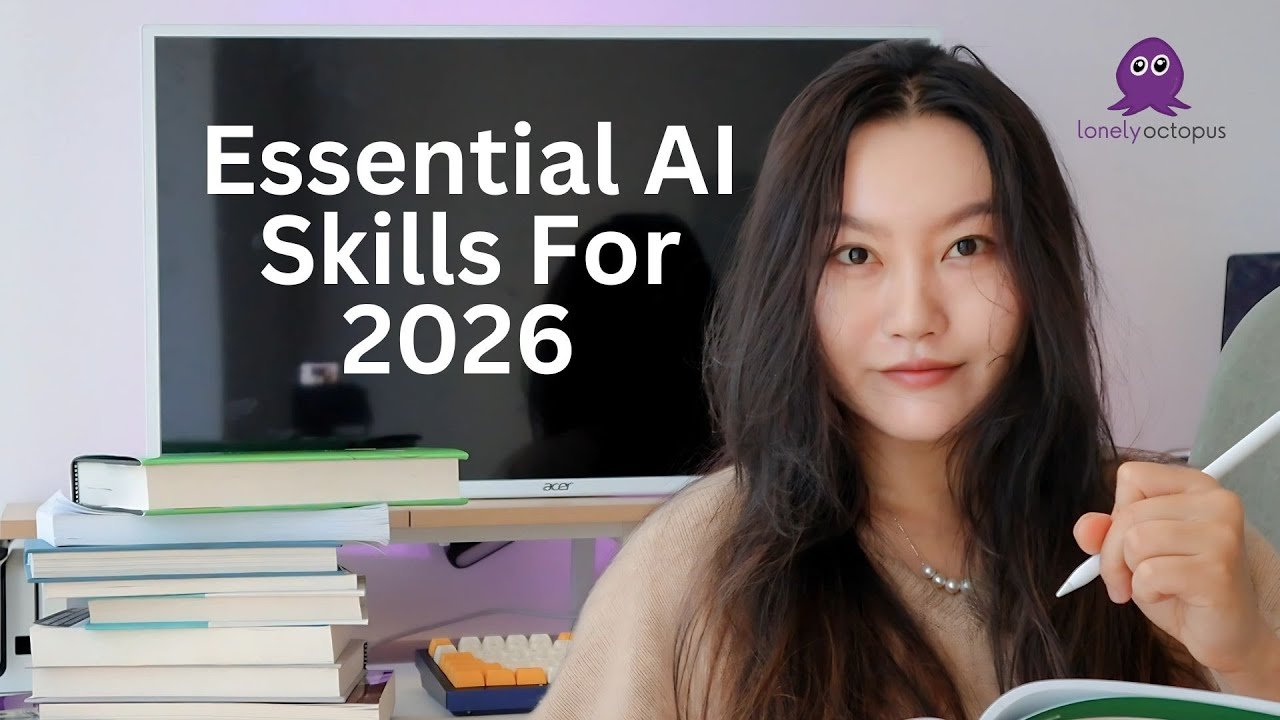
Artificial intelligence has become one of the most important technologies in the world. In 2026, AI is being used across education, business, healthcare, finance, marketing, software development, entertainment, customer service and many other industries.
As AI tools become more capable, the skills people need to work with them are also changing. You no longer need to be a professional computer scientist to benefit from artificial intelligence. Students, freelancers, business owners, marketers, designers and employees can all learn practical AI skills that can improve the way they work.
This raises an important question:
What are the top AI skills to learn in 2026?
There is no single answer for everyone. The best AI skill depends on your career, interests and goals. However, several skills are becoming increasingly useful across different industries.
The World Economic Forum’s Future of Jobs Report 2025 identified AI and big data as the fastest-growing skill category for the 2025–2030 period, followed by networks and cybersecurity and technological literacy. The report also highlights creative thinking, analytical thinking, resilience, flexibility and lifelong learning as important skills alongside technology skills.
This means that learning AI should not be about technology alone. The strongest combination is often AI skills plus human skills.
In this article, we will explore the top AI skills to learn in 2026 and explain how beginners can start developing them.
1. AI Literacy
Before learning advanced AI techniques, one of the most important skills is simply understanding how artificial intelligence works.
AI literacy means knowing the basics of AI, what different AI tools can do, their limitations and how to use them responsibly.
You should understand concepts such as:
- Artificial intelligence
- Generative AI
- Machine learning
- Large language models
- Computer vision
- Natural language processing
- AI agents
- AI automation
- Data
- AI-generated content
You do not need to become a mathematician to develop basic AI literacy.
The goal is to understand what is happening well enough to choose the right tool for a particular problem.
For example, if you need to write an article, you may use a generative AI assistant. If you need to analyze a large dataset, you may use an AI-powered data tool. If you need to automate a repetitive business process, you may use an AI automation platform.
Understanding the difference between these applications is an important first step.
2. Prompt Engineering
Prompt engineering is one of the most practical AI skills beginners can learn.
A prompt is the instruction you give to an AI system.
For example:
“Write a blog post about artificial intelligence.”
That is a very general prompt.
A more detailed prompt might say:
“Write a 1,500-word beginner-friendly blog post about the top AI skills to learn in 2026. Use simple English, clear headings, practical examples and a conclusion. The audience is students and young professionals.”
The second prompt provides more context, making it easier for the AI to understand what you want.
Good prompting involves learning how to:
- Give clear instructions
- Provide context
- Define the target audience
- Specify the desired format
- Provide examples
- Set limitations
- Ask follow-up questions
- Request revisions
- Break complicated tasks into smaller steps
Prompt engineering is useful in almost every profession that uses generative AI.
A marketer can use prompts to develop campaign ideas. A student can use them to create study questions. A programmer can use them to explain code. A business owner can use them to develop customer-service responses.
However, prompting should not be viewed as a magic formula. The quality of the final result also depends on the quality of the information and instructions you provide.
3. Generative AI
Generative AI is another major skill to learn in 2026.
Generative AI refers to systems that can create new content from instructions or other inputs.
Depending on the technology, generative AI can create:
- Text
- Images
- Videos
- Audio
- Music
- Presentations
- Computer code
Learning how to use these tools can be valuable for creators and professionals.
For example, a content creator might use AI to brainstorm video ideas, develop a script and create supporting visuals.
A small business could use AI to create advertising concepts and social media content.
A student could use AI to create practice questions and study materials.
A designer could use image-generation tools to explore different concepts before creating the final design.
The important skill is not simply knowing how to generate content. It is knowing how to direct, evaluate and improve AI-generated content.
4. AI Research and Fact-Checking
AI can make research faster, but it also creates a new responsibility: checking information.
AI systems can sometimes produce incorrect information, outdated claims or references that need verification.
That makes AI-assisted research an important skill.
A strong AI research workflow might look like this:
Ask → Research → Find sources → Verify → Analyze → Write.
For example, if you are researching a technology trend, you can use AI to identify important concepts and questions.
You can then find original reports, official websites, academic papers and credible publications.
After that, compare the information and verify important claims.
This skill is particularly important for people working in:
- Journalism
- Blogging
- Education
- Business
- Research
- Marketing
- Finance
- Technology
The World Economic Forum also notes that human oversight remains important as generative AI becomes more capable. Its analysis emphasizes that AI can augment human work rather than simply replace it, making broader AI literacy and human judgment important.
5. AI Data Analysis
Data analysis is becoming increasingly important because organizations collect enormous amounts of information.
AI can help people understand datasets without requiring them to perform every calculation manually.
AI-assisted data analysis can help with:
- Finding trends
- Identifying unusual results
- Summarizing data
- Creating charts
- Comparing numbers
- Generating reports
- Asking questions about datasets
- Identifying possible patterns
However, you should still learn basic data concepts.
Important areas include:
- Percentages
- Averages
- Variables
- Tables
- Charts
- Correlation
- Data cleaning
- Basic statistics
For example, a business owner could provide sales information to an approved AI tool and ask it to identify which products generated the most revenue.
A marketing professional could analyze campaign performance.
A student could use AI to understand a dataset for a research project.
Learning both AI and basic data analysis can therefore create a powerful combination.
6. AI Automation
AI automation is another skill that can have practical value for businesses and freelancers.
Automation means using technology to perform repetitive tasks with limited manual involvement.
Traditional automation usually follows predefined rules.
AI automation can be more flexible because AI systems can understand text, classify information and generate responses.
For example, imagine a business receives hundreds of customer emails.
An AI-powered workflow could potentially:
- Receive the email
- Identify the customer’s question
- Categorize the request
- Extract important information
- Prepare a response
- Send the information to the appropriate employee
Other possible applications include:
- Lead management
- Email organization
- Customer support
- Report generation
- Marketing workflows
- Data processing
- Appointment management
- Content workflows
Learning how to identify repetitive tasks and turn them into automated workflows can be valuable even if you are not a programmer.
7. AI Agents
AI agents are becoming an important area of AI development.
A basic chatbot generally responds to individual requests.
An AI agent can be designed to complete multiple steps toward a goal, often using tools or external systems.
For example, an agentic workflow could potentially involve:
Researching information → analyzing it → organizing the findings → creating a document → preparing a summary.
The technology is developing quickly, so learning the fundamental concepts can be more useful than becoming attached to one particular platform.
People interested in AI agents should learn about:
- Tool use
- Workflow design
- Context
- Planning
- Automation
- Human approval
- Data access
- Reliability
- Security
AI agents are especially relevant to business automation and software development.
8. AI-Assisted Coding
Programming remains an important technical skill, but AI is changing how developers write software.
AI coding assistants can help with:
- Generating code
- Explaining code
- Debugging
- Refactoring
- Writing tests
- Creating documentation
- Understanding unfamiliar code
- Building prototypes
This does not mean programmers no longer need programming knowledge.
In fact, understanding programming may become even more important because developers need to evaluate AI-generated code.
A beginner learning Python, for example, can ask AI to explain a programming concept and then practice it independently.
A developer can use AI to investigate a bug but should still test the proposed solution.
Important programming foundations include:
- Python
- JavaScript
- APIs
- Databases
- Git
- Software architecture
- Testing
- Cybersecurity
The World Economic Forum lists programming among skills that remain relevant as technology changes, while AI and machine-learning roles are among the fastest-growing technology-related jobs projected through 2030.
9. Machine Learning Fundamentals
If you want a deeper technical career in AI, machine learning is a skill worth learning.
Machine learning is a branch of AI that allows systems to identify patterns in data and use those patterns to make predictions or decisions.
Beginners can start with concepts such as:
- Training data
- Features
- Labels
- Classification
- Regression
- Model evaluation
- Neural networks
- Overfitting
- Inference
You can then learn Python and machine-learning libraries.
Machine learning requires more time and technical knowledge than basic AI prompting, but it can lead toward careers such as:
- Machine learning engineer
- AI engineer
- Data scientist
- Research engineer
- Data analyst
The World Economic Forum identifies AI and machine learning specialists among the fastest-growing job roles by 2030.
10. AI Cybersecurity
Cybersecurity is becoming increasingly important as organizations use more AI and digital systems.
AI can help cybersecurity teams analyze information and identify suspicious activity, but AI can also introduce new risks.
People learning AI should therefore understand basic cybersecurity principles.
Important topics include:
- Data privacy
- Authentication
- Access control
- Phishing
- Secure coding
- Data protection
- AI security
- Prompt injection
- Sensitive information handling
You do not need to become a cybersecurity expert immediately.
Even basic security awareness can prevent serious mistakes.
For example, someone using AI at work should understand why confidential company information should not automatically be pasted into a public AI service.
The World Economic Forum lists networks and cybersecurity as the second-fastest-growing skill category after AI and big data in its 2025–2030 outlook.
11. AI Ethics and Responsible AI
Technical knowledge alone is not enough.
As AI becomes more powerful, people need to understand how to use it responsibly.
Important AI ethics topics include:
- Privacy
- Bias
- Copyright
- Misinformation
- Deepfakes
- Transparency
- Accountability
- Academic integrity
- Human oversight
For example, an AI-generated image may look realistic, but that does not mean it should be presented as a real photograph.
Similarly, AI-generated information should not automatically be treated as factual.
Responsible AI means understanding both the possibilities and limitations of the technology.
This skill is especially important for people working with sensitive information.
12. AI for Marketing
Marketing is another area where AI skills can be valuable.
AI can help marketers with:
- Market research
- Customer research
- Content ideas
- Advertising concepts
- Email campaigns
- Social media planning
- Competitor research
- Data analysis
- Customer segmentation
However, marketers still need human judgment.
AI can generate hundreds of advertising ideas, but it does not automatically understand a company’s customers as well as someone who has studied the market.
The strongest approach is often:
Marketing knowledge + AI + customer data + human creativity.
Learning how to use AI without losing the human side of marketing can therefore be an important professional skill.
13. AI Content Creation
Content creators can benefit significantly from AI.
Bloggers, YouTubers, social media managers and online businesses can use AI throughout their production process.
For example:
Idea → Research → Outline → Draft → Editing → Visuals → Social media promotion.
AI can assist at several stages.
However, creating large amounts of generic AI content is not necessarily a successful strategy.
Good content still needs:
- Original ideas
- Accuracy
- Useful information
- Experience
- Personality
- Good storytelling
- Audience understanding
The best content creators will likely use AI to increase their productivity while keeping human creativity at the center.
14. AI Communication Skills
One of the most overlooked AI skills is communication.
You need to communicate clearly with AI to get useful results.
You also need to communicate clearly with people when explaining AI-generated information.
This means learning how to:
- Define a problem
- Explain context
- Set objectives
- Ask precise questions
- Give examples
- Review responses
- Identify mistakes
- Communicate findings
Good communication can improve your results with almost every AI system.
15. Analytical and Critical Thinking
AI skills should not replace thinking.
They should strengthen it.
The World Economic Forum continues to identify analytical thinking as a leading core skill, with seven out of 10 companies surveyed considering it essential. Creative thinking is also among the skills expected to rise in importance.
This matters because AI can generate an answer without necessarily knowing whether that answer is appropriate.
A person with strong analytical thinking can ask:
- Is this information accurate?
- What evidence supports it?
- What is missing?
- Are there alternative explanations?
- Does this solution actually solve the problem?
- What could go wrong?
These questions make AI more useful.
16. Creative Thinking
AI can generate content quickly, but creativity remains important.
Creative thinking helps you develop original ideas, identify opportunities and solve problems in unusual ways.
This is why learning AI should not mean abandoning creativity.
Instead, combine the two.
For example, a designer could use AI to generate 20 concepts and then use human creativity to combine the best ideas into something original.
A marketer could use AI to brainstorm campaign concepts and then develop a unique strategy based on customer knowledge.
The World Economic Forum lists creative thinking among the skills expected to increase in importance through 2030.
17. Continuous Learning
AI changes extremely quickly.
A tool that is popular today may be replaced or significantly updated tomorrow.
That means one of the most important AI skills is learning how to keep learning.
You should develop the habit of:
- Testing new AI tools
- Reading documentation
- Following major AI developments
- Building projects
- Taking courses
- Experimenting
- Learning from mistakes
The World Economic Forum specifically identifies curiosity and lifelong learning among skills expected to rise in importance through 2030.
This is particularly important because AI skills are not something you learn once and finish.
Which AI Skills Should Beginners Learn First?
If you are completely new to AI, trying to learn everything at once can become overwhelming.
A better approach is to follow a simple path.
Step 1: Learn AI Basics
Understand what AI, generative AI, machine learning and AI agents are.
Step 2: Learn Prompting
Practice writing clear instructions for AI systems.
Step 3: Learn AI Research
Learn how to find, compare and verify information.
Step 4: Learn AI Productivity
Use AI for writing, brainstorming, summarizing and planning.
Step 5: Learn Automation
Identify repetitive tasks and learn how to automate them.
Step 6: Choose a Specialization
Choose one area based on your goals.
For example:
Content creator: Generative AI + content creation + video and image tools.
Marketer: AI research + marketing + automation + analytics.
Developer: AI coding + Python + machine learning + AI agents.
Business owner: AI automation + research + marketing + data analysis.
Student: AI literacy + prompting + research + study workflows.
AI Skills and the Future of Work
The demand for AI-related skills is connected to a broader transformation in the workplace.
The World Economic Forum’s Future of Jobs Report 2025 surveyed more than 1,000 employers representing more than 14 million workers and estimated that 39% of workers’ existing skill sets could be transformed or become outdated between 2025 and 2030.
The report also projects significant growth in technology-related roles, including big data specialists, AI and machine learning specialists, fintech engineers and software developers.
This does not mean everyone needs to become an AI engineer.
Instead, it suggests that AI literacy and technological adaptability are becoming increasingly useful across different careers.
The World Economic Forum’s analysis of Nigeria also identifies AI and big data among the skills expected to see increased demand, showing that these trends are relevant beyond major technology markets.
Final Thoughts
So, what are the top AI skills to learn in 2026?
Some of the most useful include:
- AI literacy
- Prompt engineering
- Generative AI
- AI research and fact-checking
- Data analysis
- AI automation
- AI agents
- AI-assisted coding
- Machine learning
- AI cybersecurity
- AI ethics
- AI marketing
- AI content creation
- AI communication
- Analytical thinking
- Creative thinking
- Continuous learning
You do not need to learn all of these skills at the same time.
Start with the basics and choose skills that match your goals.
If you are a beginner, start with AI literacy and prompting.
If you are a content creator, learn generative AI, AI content creation and AI-assisted research.
If you are interested in business, focus on AI automation, marketing, data analysis and AI agents.
If you want a technical career, consider Python, machine learning, AI engineering, data science and AI-assisted coding.
Most importantly, remember that AI tools will continue to change. Learning how to use one particular platform is useful, but developing broader AI knowledge is more durable.
The goal should not be to become dependent on AI.
The goal is to become someone who knows when to use AI, how to use it, how to check its results and how to combine it with human creativity and judgment.
AI is becoming part of the modern workplace, and the people who learn to work effectively with it can position themselves to adapt as technology continues to evolve.
The most valuable AI skill may ultimately be the ability to keep learning as AI itself changes.